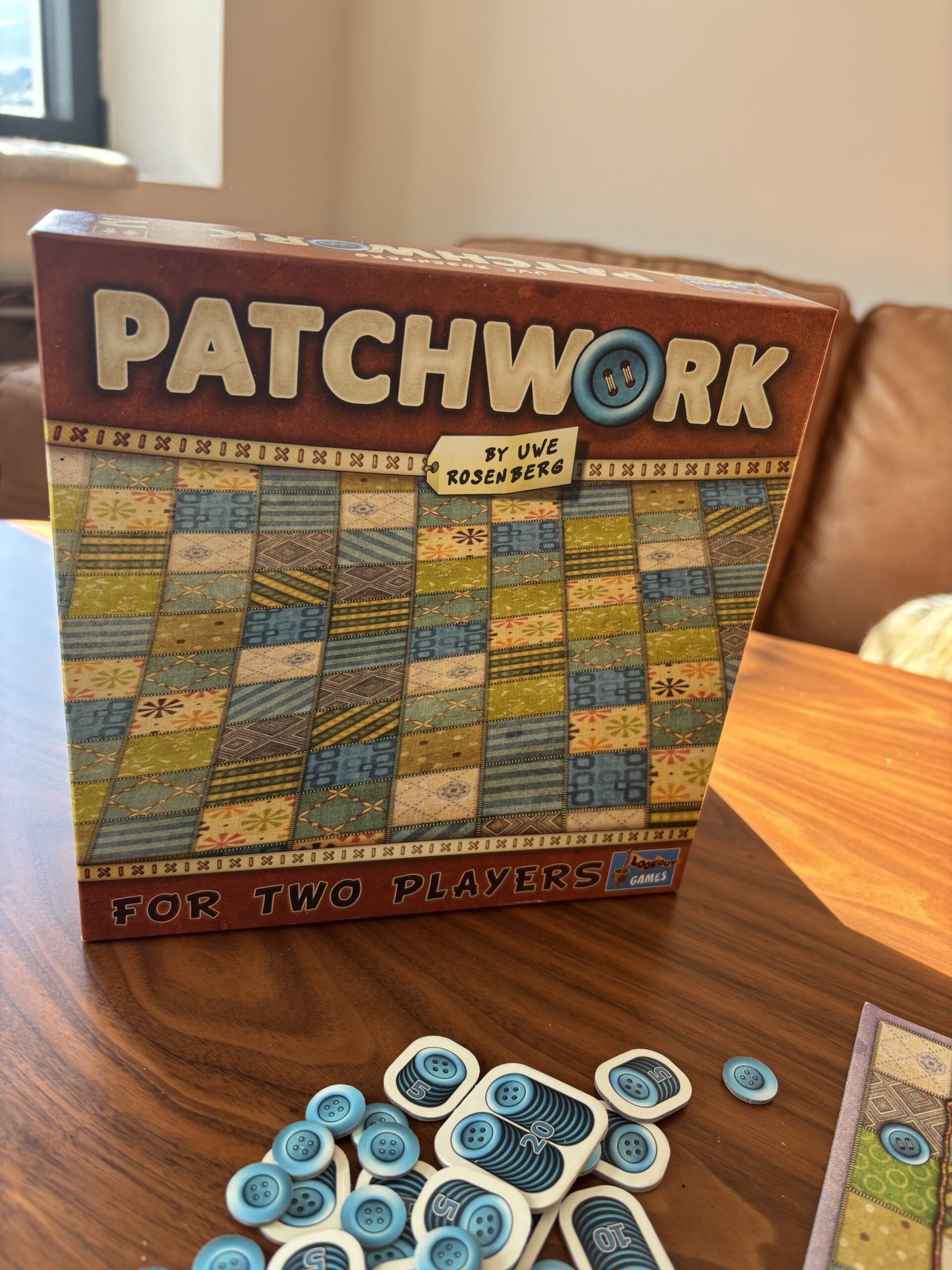
Michelle and I often play cooperative two player games, for example I’m sure we’ve mentioned playing Gloomhaven. I won’t put words in Michelle’s mouth but I think it is safe for me to say that she doesn’t love games with excessive direct conflict between players. I bought Patchwork thinking it would be a good fit for our playstyle and its small box and play area make it a convenient choice for traveling.
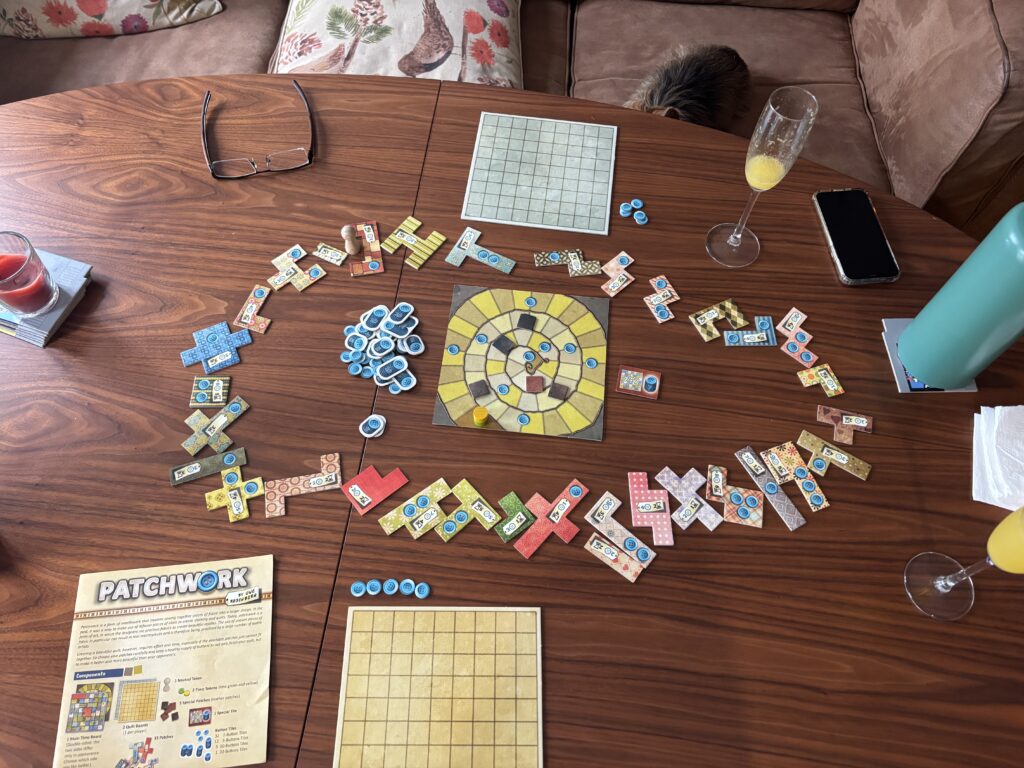
In Patchwork both players are trying to sew together the best quilt using a jumbled assortment of fabric pieces. At the end of the game the player who has the largest quilt and collected the most buttons is the winner. Below is a picture of the game set up, take a look and then I’ll dig a little deeper into the gameplay.
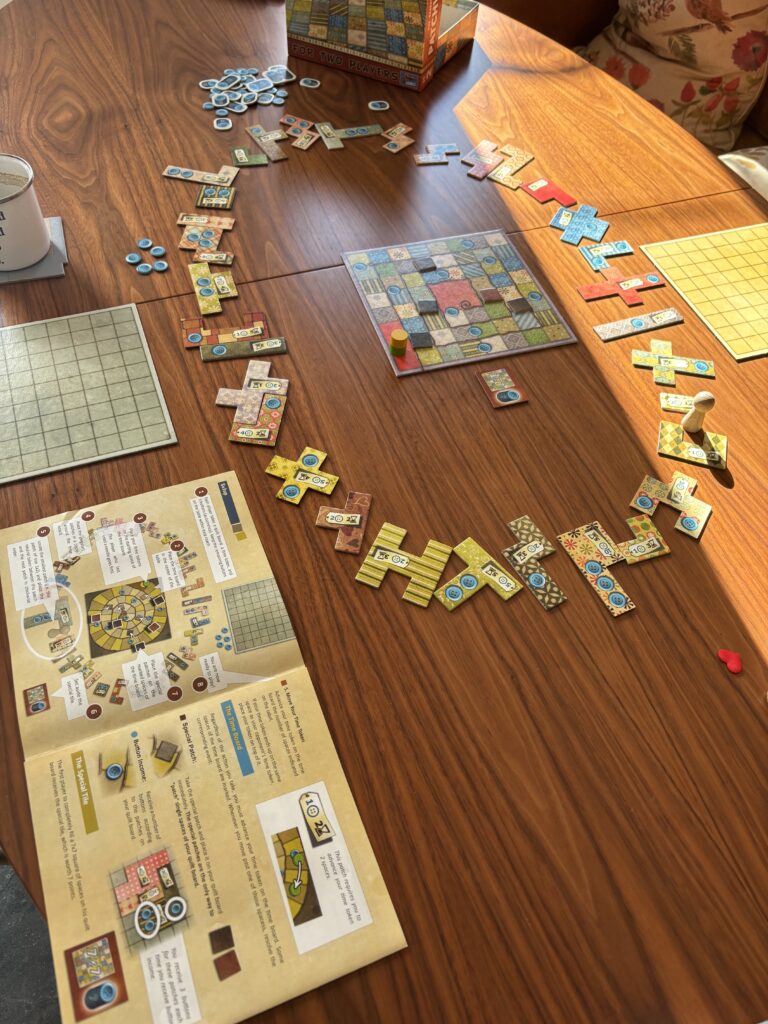
After setting out the quilt pieces randomly each player gets an empty quilt board, five buttons (which act as both points and currency) and sets their “time token” at the starting position. Let’s take a closer look at that board.
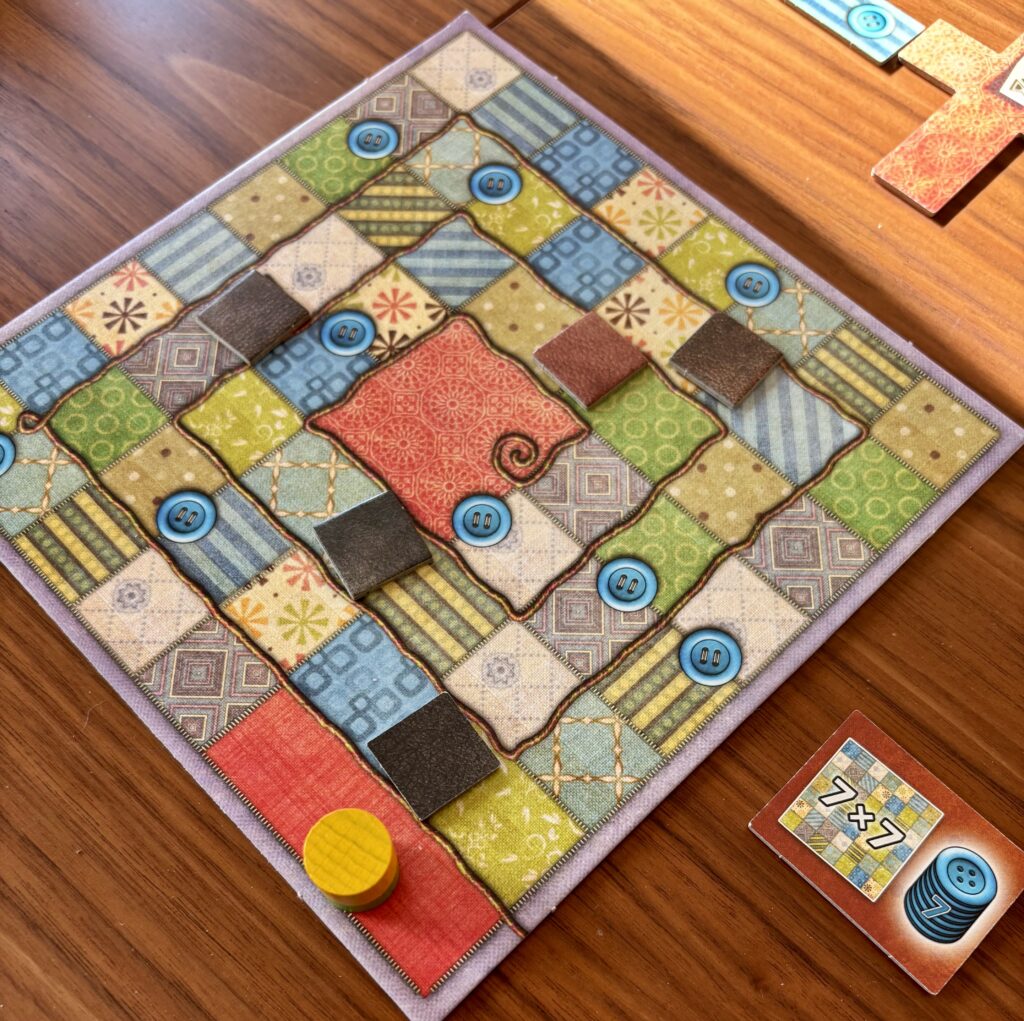
This is how the time board looks at the start of a game, in this case the yellow player is going first so their time token is on top. In addition to buttons and quilt size, time is the third major factor in Patchwork. As time passes your token moves forward on the time board and when it passes a button you gain buttons equal to the number currently stitched into your quilt. There are also five 1×1 tiles that are awarded to the first player who passes them on the time board.
The player who is furthest back on the time board (or on top if both players are on the same spot) takes a turn, even if that means they take multiple turns in a row. The game continues until both players reach the final spot in the center of the time board.
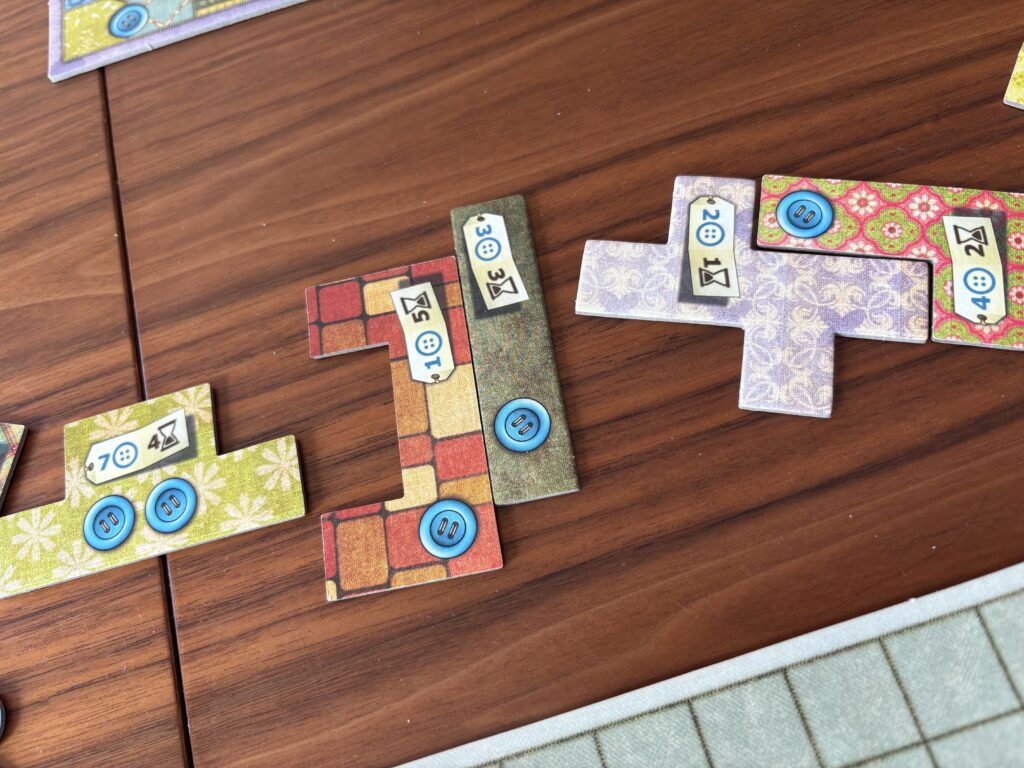
Here you can see a close up of some fabric pieces. Each piece shows a cost in buttons (the number followed by a blue button symbol), and a cost in time (the number followed by an hourglass icon). Pieces come in a variety of sizes and shapes and some include button symbols which indicate potential income.
Gameplay is quite straightforward, on your turn you have two choices. First, you can simply move your token into the space directly in front of the other player’s token and gain one button per space moved. Second, and more commonly, you can choose one of the three patches clockwise in front of the pawn (see the first picture including the pawn). Once you choose a patch you must take a series of actions: move the pawn into the spot previously occupied by that patch, pay the button cost of the patch, place the patch onto your player board (it cannot overlap any other patches or hang over the edge), and finally move your time token forward based on the time cost listed on the patch.
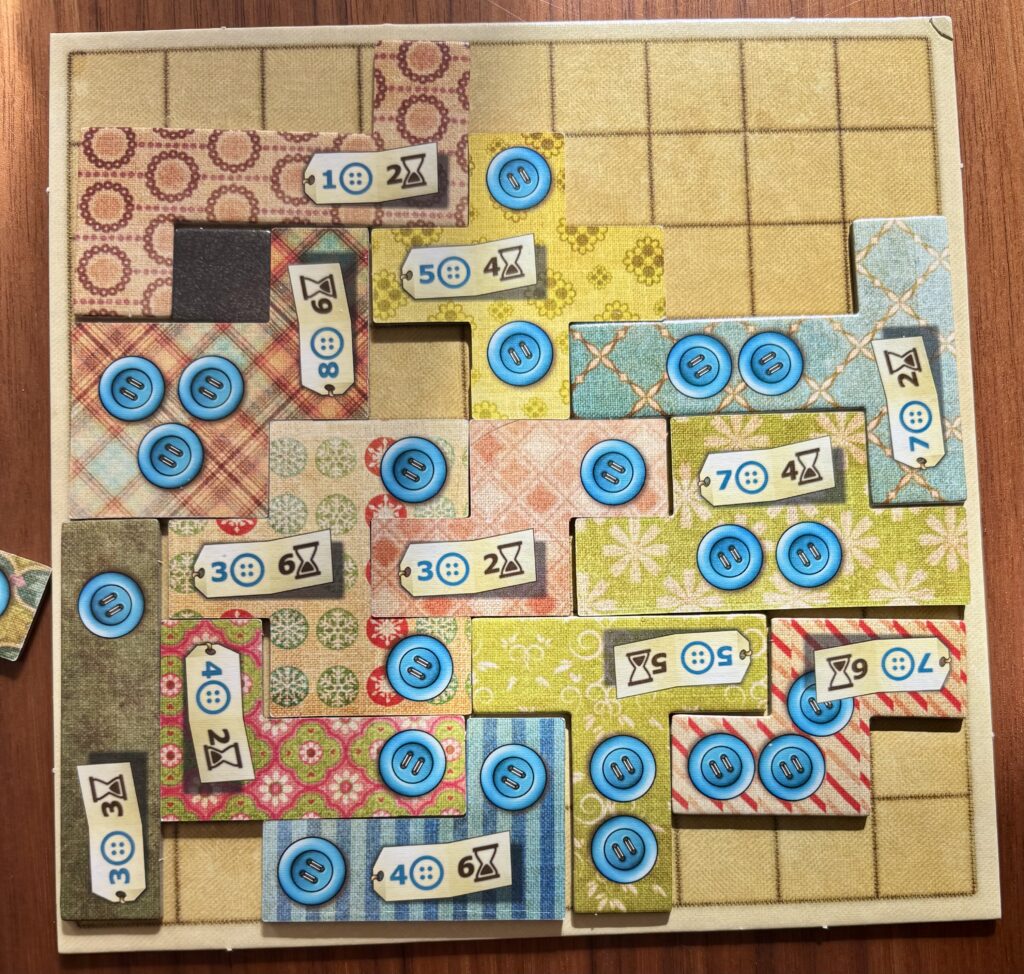
After both players time tokens have reached the center space, players add all the buttons they have gathered, the first player who fills a 7×7 portion of their board gets a 7 point bonus (which does not always happen) and then the players subtract two points for each empty space on their quilt boards.
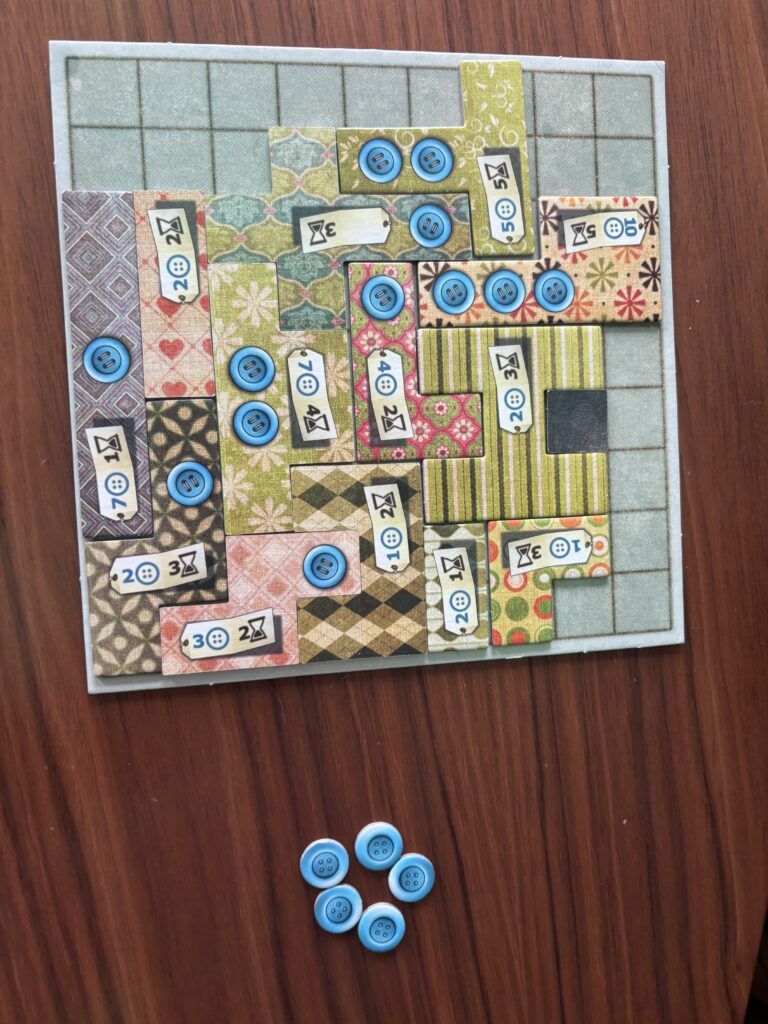
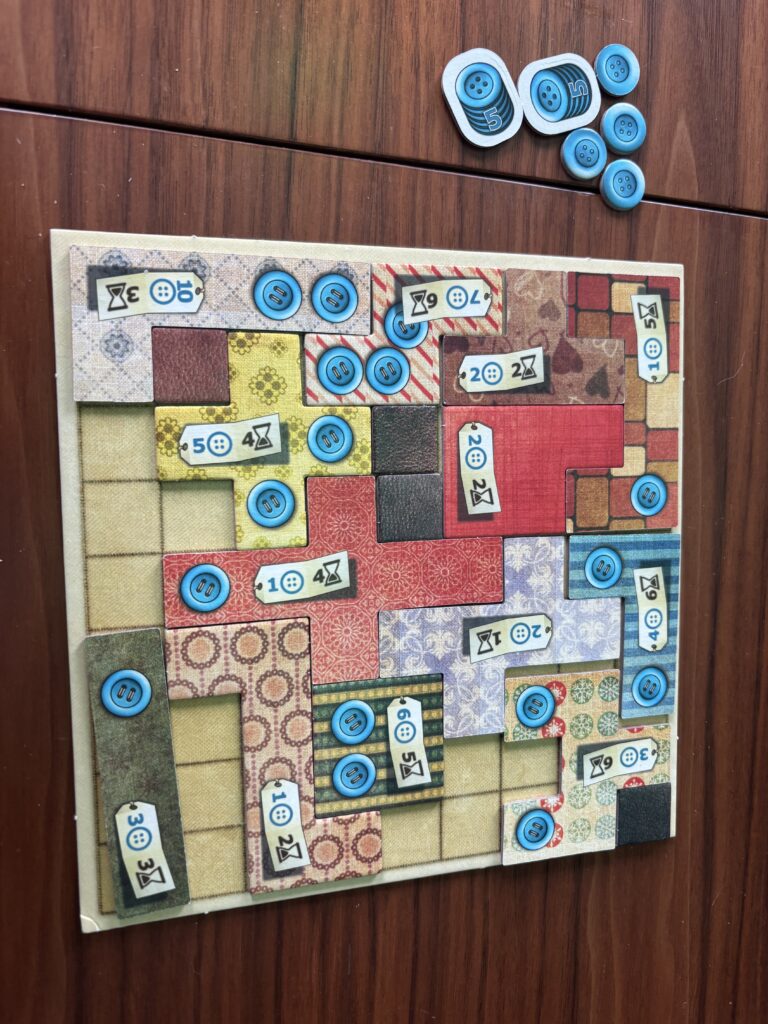
Above you can see Michelle and my quilt boards at the end of our most recent game. This was the first time I’ve won the game, but we both agree that a win in Patchwork often feels like a pyrrhic victory.
Before I dig deeper into the review I do want to mention the designer, Uwe Rosenberg. Mr. Rosenberg is a prolific board game designer who published his first game (Bohnanza) in 1997. According to Board Game Geek his most popular games include A Feast For Odin, Caverna, and Agricola. All three of those games share variations of the mechanic where you cover spaces on your playing area to avoid negative points at the end of the game; however, all three are much more complex and strategic.
Win or lose, Michelle and I have both felt underwhelmed when we finish a round of Patchwork. Preparing for this blog post I’ve spent a lot of time contemplating the reason for this and I think I’ve come to some understanding.
First, Patchwork claims to be about making a “better and more beautiful quilt than your opponent’s” but this isn’t really the case. Points are button based and filling the most spots on your board or having the most cohesive quilt is NOT the key to winning. Since we both love spatial puzzles (jigsaw puzzles or Tetris for example) our natural tendency is to focus on filling our board in a pleasing and logical way. With this gameplay style, that usually means the player who felt they succeeded in having a “pretty quilt” actually ends up losing the game.
The second reason has to do with game tension. Most games I enjoy build tension in some way. This might mean you push your luck trying to get the perfect card or work to make a grand strategy come together. Often there is some level of risk involved, or an opportunity for your opponent to out strategize you or even undermine your plans. Patchwork has almost none of this tension, occasionally your opponent may take a quilt piece you want or get more of the 1×1 bonus pieces, but that is rarely the deciding factor in a game.
And my final conclusion, and what I think may be the ultimate buzz kill for me, is that this game really just boils down to relatively simple mathematical decisions. I didn’t think about this while playing, but I think players probably subconsciously and intuitively understand this while playing. I’m going to do a detailed breakdown about this at the very end of this post for anyone interested, but the simple explanation is that on each turn you have four choices and you can essentially assign a numerical “button value” to those choices and in almost all cases the highest value is probably the best choice.
There are Patchwork tournaments and high level players who have fine tuned and advanced strategies, but that isn’t what Michelle and I are looking for in this type of game. We own plenty of board game options that are more serious and require more thought and patience which also provide a more satisfying interaction and ending.
A lot of people love Patchwork. It is relaxing, simple to play and explain, and is pleasant to look at. Michelle and I will be writing about some classic games like Rummikub and Dominoes in the upcoming weeks and I think there is a refreshing straightforwardness to both of them that serves as an enjoyable contrast to Patchwork. Rosenberg’s (much) more complex games like Caverna work because there are hundreds of interesting and meaningful decisions made by the players as they choose how to cover their player boards. Stripping down a game to such a basic level took most of the fun out of it for me.
In Patchwork each player starts with 5 buttons and 81 blank spots on their quilt board, or -157 points. There are 53 spots on each time board so if a player did nothing but move their token forward each turn they would end the game at -104 points. This shows that, except when you desperately need a few buttons or at the very end of the game, just taking buttons is rarely the optimal choice.
Each available piece is worth 2 buttons per square, plus if it gives button income that income needs to be multiplied times the remaining buttons on the time board. If you gain a bonus 1×1 patch it is worth 2 points and for simplicity sake each time passed is worth something just over -1 point. This all sounds convoluted but like I said, I think players naturally work out the gist of this. Often a player can only afford one or two of the available pieces making the choice even simpler.
I believe that during any given game there will only be a few turns where a player needs to consider anything but this very basic valuation of their action. Taking a suboptimal move (losing 4 or more buttons in value) will almost never be worth blocking your opponent. The one exception mid game would be when a player might aim to get the 7 point bonus token, but our experience has shown that aiming for that token doesn’t guarantee a win.
That’s the basic strategy I’ve come up with for Patchwork since the last time I played. Next time you visit I’ll dust it off and we can play a round to see if my theory holds water. In the meantime I think Michelle and I will stick to other games.


2 responses to “Patchwork”
You both take advantage of what life has to offer. Sweet. Aunt Peggy
We do our best, thanks Aunt Peggy!