
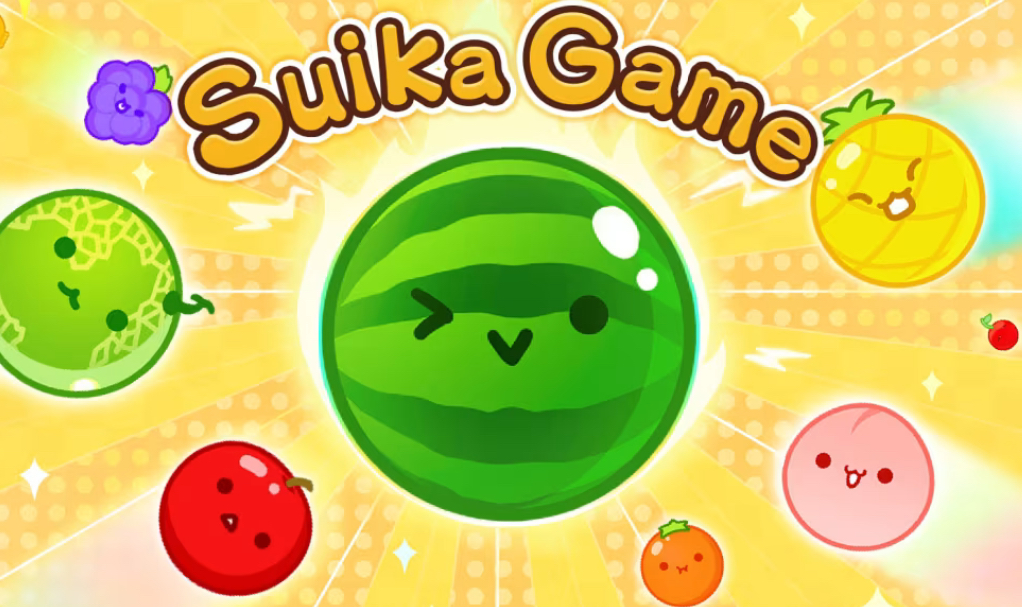
Once or twice a year Michelle and I sink our teeth into a video game that we play individually but simultaneously. We almost always have a game we are playing cooperatively, but Suika Game is a separate type of play where we each do our own thing. The two experiences lead to very different conversations with each other. This practice started when we worked in dispatch but has continued after retirement.
Our normal fare for concurrent play is usually a big game with lots of content and lots to talk about like Legend of Zelda, Stardew Valley, or Hogwarts Legacy. Last year we somehow stumbled into something different in Suika Game.
Suika Game was originally a low budget Nintendo Switch game only available in Japan. The game became popular with online streamers for a while and was eventually made available worldwide. Our time playing together (but separately) came well after the streaming fad had simmered out.
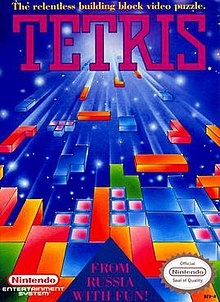
I originally bought Suika Game because I am a huge fan of falling block puzzles, like Tetris. In Tetris different shape combinations fall from the screen and you quickly arrange those shapes to complete horizontal lines which then disappear from the playing field. But, you have almost certainly played Tetris and already know that.
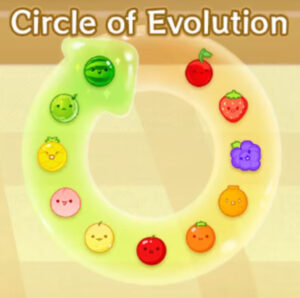
Suika Game‘s falling pieces are fruit, ranging in size from cherry to watermelon. When two matching types of fruit touch each other they immediately combine into the next larger type of fruit. Each match also gives the players points based on fruit size. If non matching fruit is adjacent it just stacks up. The game ends when any piece of fruit reaches a line at the top of the screen.
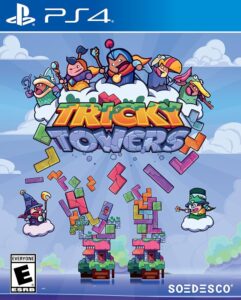
Normally pieces in falling block games are… blocks. They stack in predictable towers, usually straight up to the top of the screen. This rule is so pervasive that there was a very popular game in 2016 (Tricky Towers) that subverted the norm by letting its growing towers topple. Many games have had “blocks” that are not actually squares but still stack like they are (Dr. Mario, Puyo Puyo, and Bejeweled are a few examples).
Before really digging into the mechanics of Suika Game I need to bring up one more example, Synthetic Watermelon, a Chinese mobile game that came out months before Suika and is almost exactly the same game. The Suika Game developer (Aladdin X, a Chinese subsidiary based in Japan) borrowed heavily from Synthetic Watermelon to make a simple game they wanted to pre-install on the digital projectors they sell. They realized that their customers were loving the game and then worked to develop a version that could be released on the Nintendo Switch. The origin story is more complicated than the actual game!
So, what made Synthetic Watermelon and Suika Game different from other stacking games? The fruit in these games is actually fruit shaped. Thankfully most fruit is round, but two of the most common types in the game (strawberries and grapes) are definitely not. Being in the digital projector business and not game development likely meant that Aladdin X probably had different priorities.
I’ve got to make some guesses about Suika Game’s development here but I do believe that the reasons the game is so uncannily addictive and frustrating are attributable to those different priorities. First, modern game developers would likely have fudged the fruit shapes so they interact more predictably and pleasingly. For example, in a different game I play (Rocket League) players drive cars to hit giant soccer balls. But cars have pointy bits all over which would make the ball fly all over the place in complete chaos. On the other hand having square boxes as cars doesn’t look cool at all. So, the programmers make the cars look cool but separately program a different shape behind the scenes that is the vehicle’s actual interactive space, this is called a hit box.
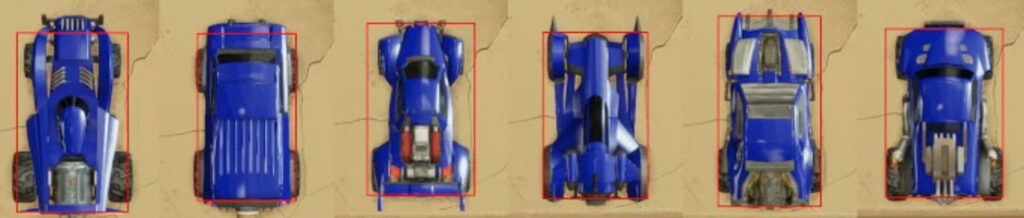
As far as I can tell Suika’s fruit is just as it appears with the possible exception of the stems. The second thing that is different in Suika is the game’s physics boundaries. The physics in a game dictate how and when things move. Movement in games is dictated by math and the more moving pieces there are, the more math that has to be done. Suika Game is small enough that having every piece of fruit constantly move doesn’t really cause problems for the computers running the software but to a modern gamer it looks sloppy at first glance. Many developers would have programmed it so that if a piece of fruit is moving very slowly the physics making it move would pause until something changes (its position or how another piece of fruit is touching it). Nope, in Suika fruit will move and rotate at a nearly imperceptible rate for infinity.
A person might argue that it’s cute to have a screenful of slowly spinning fruit, but this decision has gameplay consequences. If two grapes are both spinning at different speeds and very near each other, given enough time their end bits may touch. This amount of time could be a few seconds, days, or anywhere in between. As a player how long do you wait for a potential favorable outcome or how fast do you have to play for a potential negative combination?
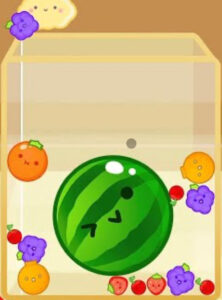
Next, remember how I said fruit immediately combines in Suika? I meant IMMEDIATELY which means two small pieces of fruit combine to a slightly larger piece which is now very likely sitting in a space which is literally too small to contain it. Usually this is fine, but occasionally when the fruit is tightly packed this causes what we call a “pop” that explodes the surrounding pieces outward. A pop can literally send a piece of fruit from the bottom to the top of the screen ending your game in an unforeseen instant. Also, remember the never-ending physics? These make it so that an unexpected pop can happen at any time.
What is bizarre about all of these things is that they are individually frustrating but combine to make a game which is extremely satisfying to play. There is a real sense of having overcome the odds when you manage to combine up to a watermelon. The inconsistency is a constant hurdle, but with continued play we both had high scores that increased as our skills ever so gradually improved.
Michelle and I spent well over a combined 200 hours working to get a double watermelon combination. We both still boot up the game for a round and dream of achieving that goal but neither of us spend anywhere near the time we did during our concurrent play. Since we can share our digital switch games we only paid $2.99 for this fun experience, and the game is now also available on iOS and Android.
Normally when we play a game together like this we have in depth discussions. These were absent during Suika Game because here isn’t a strategic trick that you can come up with, it’s more about feeling out how different fruit sits on top of other fruit. We would show each other our game when we had a good start or had a horrid pop, and of course compare high scores.
Most video games gloss over the faults of reality. Behind the scenes your piece gets nudged into place or the in-game gravity cheats to prevent an unfair game ending pop. There are rules in place that the player can easily understand and interact with. Suika Game for all its faults is more realistic in that sometimes a well laid plan just won’t work out – fairness be damned. You grumble a bit, maybe show a friend your misfortune, and move on to the next set of fruit stacking problems.

A friend and former coworker recently asked if we miss dispatching and we resoundingly answered “NO, ZERO percent”. I think that we will always find an uncommon pleasure in certain types of stress, but we can confidently get those dopamine hits in so many ways that don’t include our or anyone else’s trauma. Like spending an hour both getting angry at digital strawberries and grapes.
Try out Suika Game and share your high scores in the comments!


2 responses to “Suika Game”
Happy retirement to two deserving people. You were great public servants. Power to the people. Aunt, Peggy
Thanks Peggy, we did our best. =).