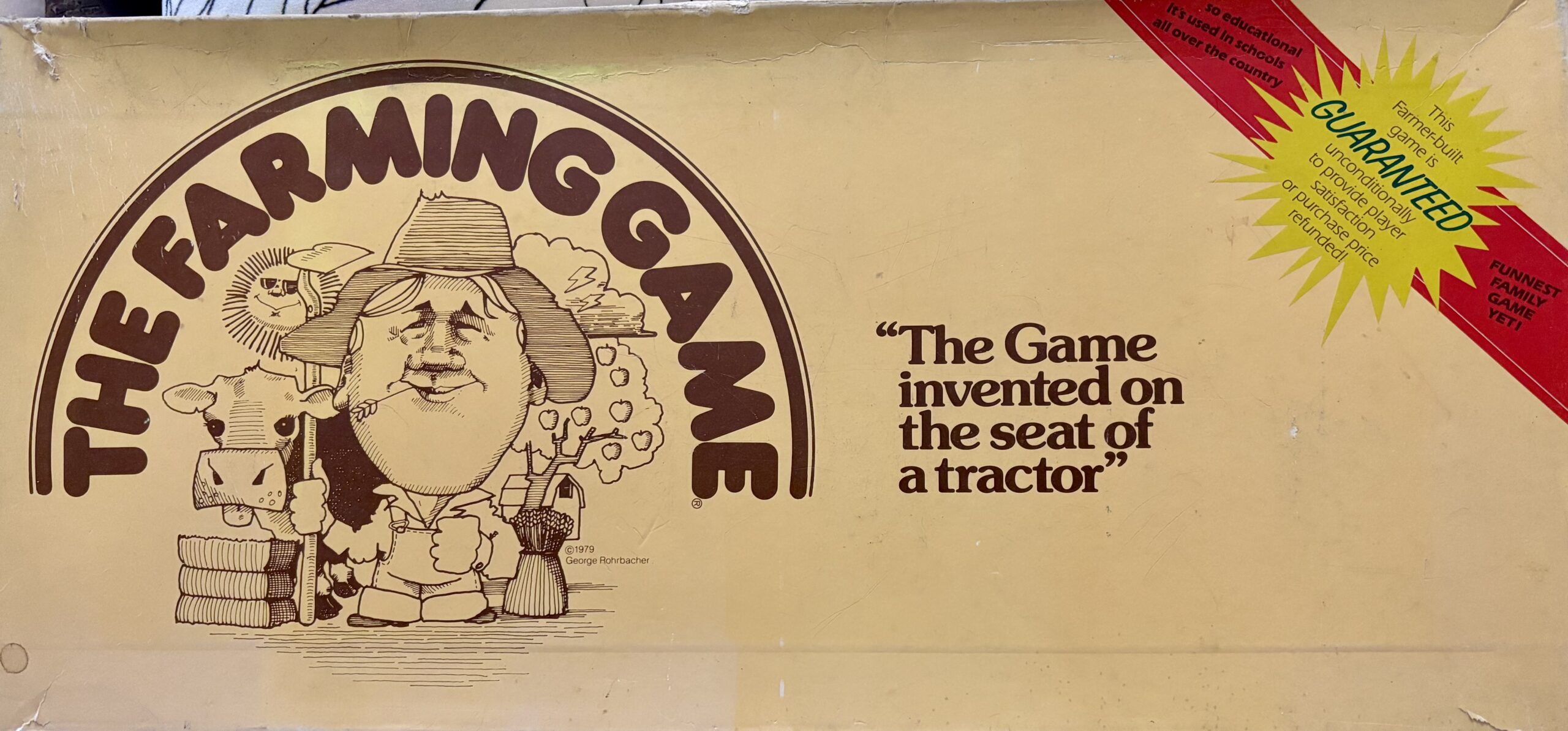
My grandpa Finazzo was a farmer in Minnesota, he had a farm and a tractor and the whole shebang. Like most farmers he supplemented his income in a variety of ways but his core identity was related to tending to his crops. I imagine sometime around 1979 someone saw the new board game The Farming Game at JC Penney and thought it would make an excellent birthday or Christmas gift.
This wasn’t a horrible gift idea since Grandpa did enjoy games, but he generally would choose to play the national game of Australia, 500. The aunts and uncles would sneak in a round of Trivial Pursuit or maybe even Taboo on a spicy night. but I don’t know if The Farming Game ever hit the table for its intended audience.
Fast forward 13 years or so and me and my cousins dug up The Farming Game in the back of the cupboard where the games were snookered away. Over the next 15+ years many hours were whiled away on holidays and other family gatherings in heated games with intense fights for the largest cherry tree crop. When Grandpa passed away and Grandma asked if there was anything I wanted as a keepsake I quickly settled on The Farming Game. There was never any doubt it would travel with us to Portugal when we moved.
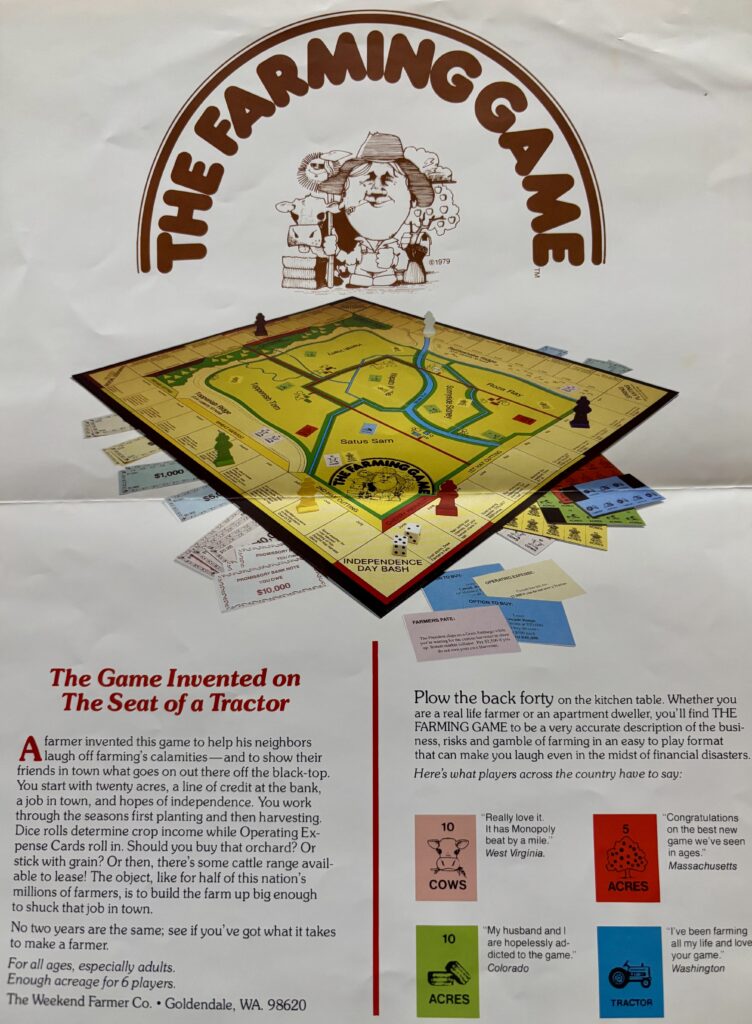
Last week we had some friends over and let them choose between three games and they settled on my childhood classic as our entertainment for the night. So today I’ll dive into “The Game invented on the seat of a tractor”.
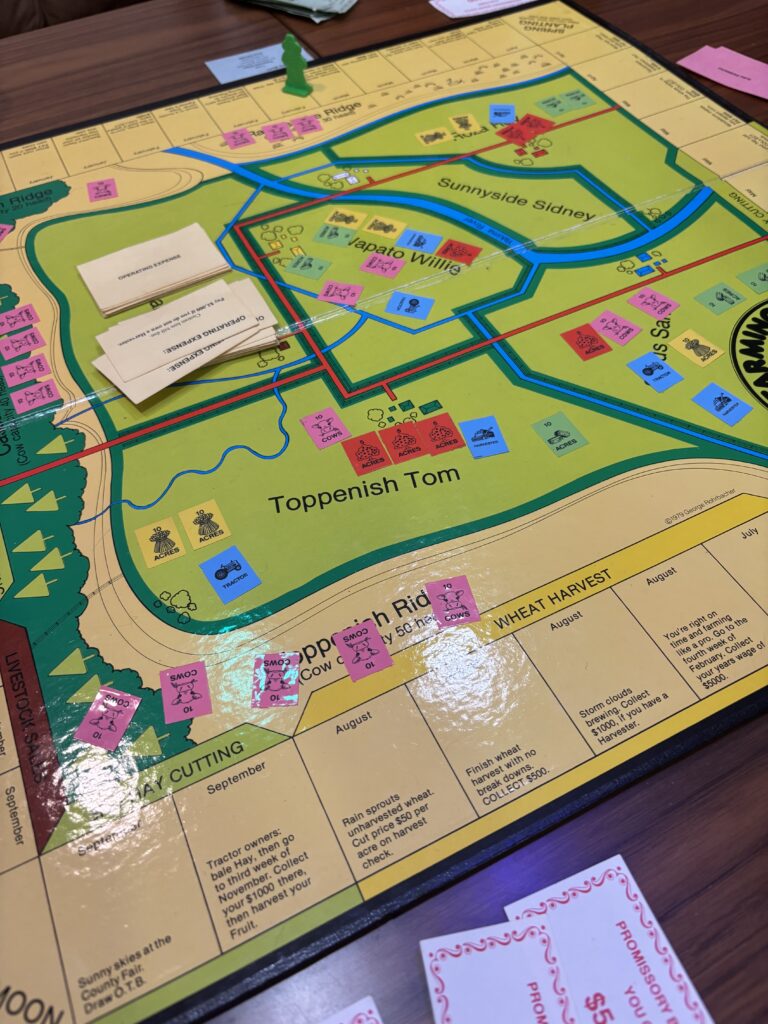
The game designer George Rohrbacher isn’t credited with any other games and I truly believe the creation story presented on the box, the rulebook, and a separate flyer put into the box about his on the job inventing spree.
Each player chooses a farmer who owns a farm positioned in the middle of the very Monopoly-like game board. You have inherited the land along with 10 acres of hay, 10 acres of wheat, $5,000, and a $5,000 IOU to the bank. You are also randomly dealt two O.T.B. (option to buy) cards.
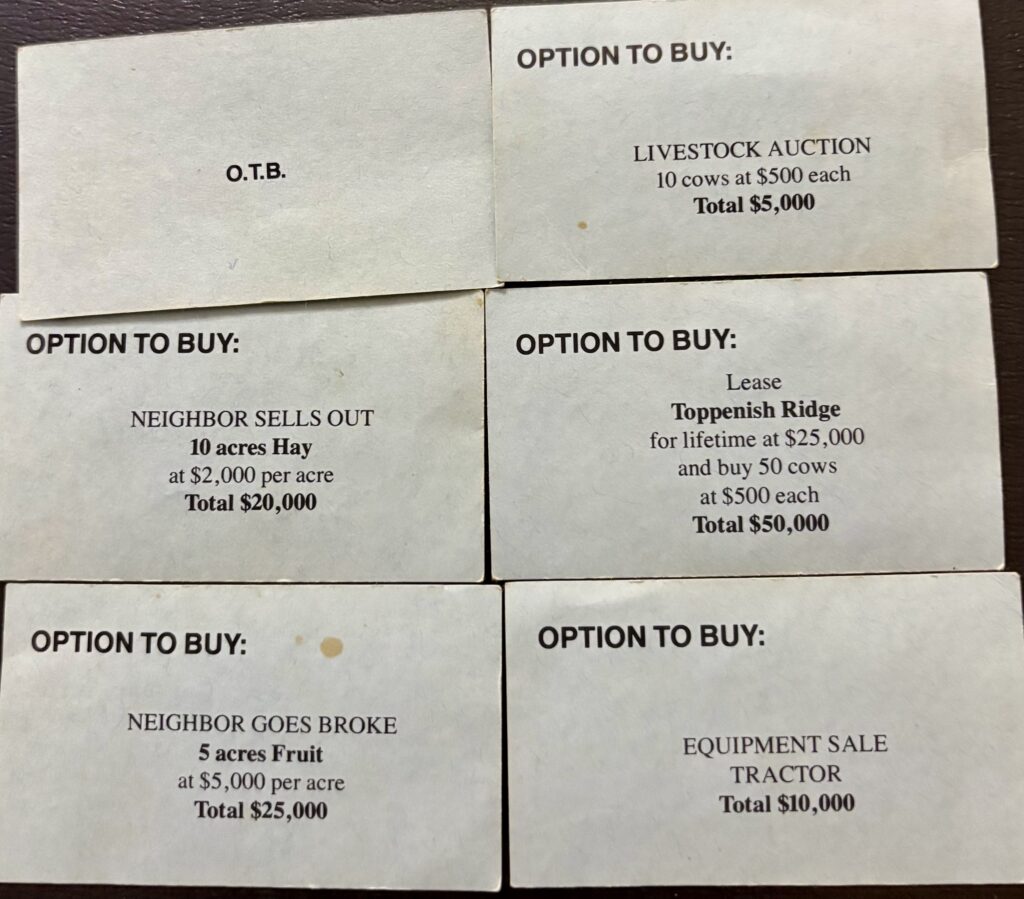
Players are racing to earn a quarter million dollars worth of assets (cash and purchases minus bank debt). The game has multiple interesting concepts. First, the board represents a year with winter being the time you can make purchases, and the rest of the year divided between different harvesting opportunities. You can purchase items listed on your O.T.B. cards with 20% cash down but your bank borrowing limit is $50,000.
In addition to the harvesting opportunities every space but one on the board (Independence Day!) gives an additional action. These actions include gaining money, losing money (much more common), increased or decreased profit one time or for a whole season on specific crops, gaining O.T.B. cards, occasionally moving to a specific spot on the game board, or drawing a dreaded Farmers Fate card.
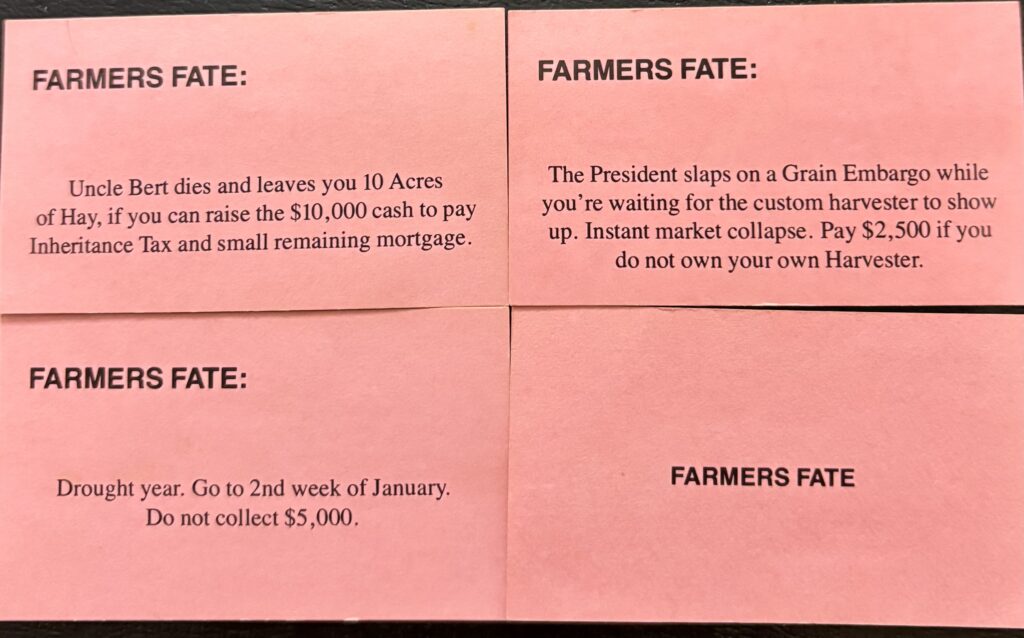
Farming is brutal in real life and this roll and move game slams that point home. Every player has a second job and when you get all the way around the board you collect those wages ($5,000) which you will then likely sink right back into the purchase of some hay that will likely never actually be worth what you pay for it during the game .
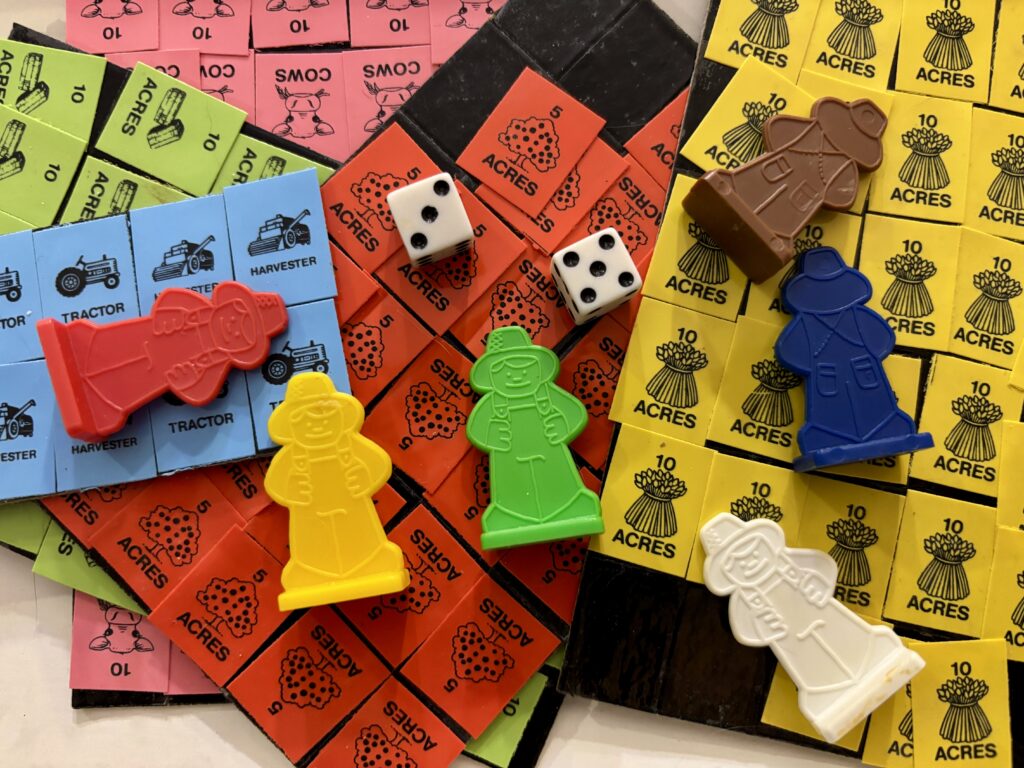
During the game you collect acrylic stickers representing your acreage of wheat, hay, fruit, and heads of cattle. You can also buy one harvester and one tractor which usually just help you avoid paying penalties listed on Farmers Fate cards.
The second really interesting thing is how the game handles your farming income. The first time during a year that you land on a harvest (like Wheat Harvest) you roll a dice and consult a chart to determine the payout. Before the banker gives you this income you draw an Operating Expense card and deduct the amount listed from your paycheck. During the beginning of the game the Operating Expense will often be more than your actual income.
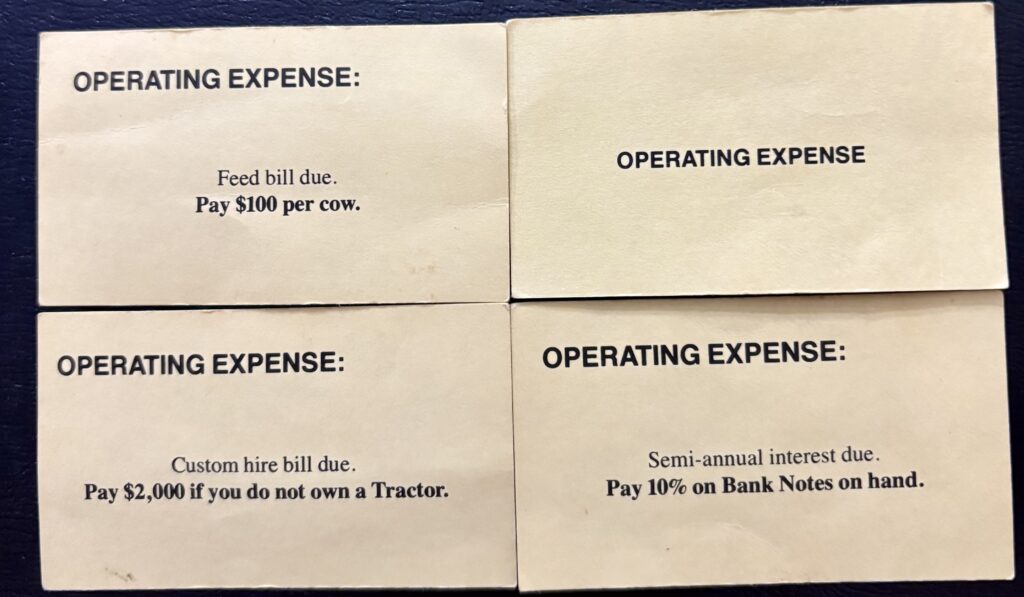
Looking at the above examples let’s say you are rolling for income on your inherited ten acres of Hay. The most you can hope to earn is $3,000 and if you roll anything below a five and draw that custom hire bill card you will owe the bank money. Here is the payout chart in all its glory.
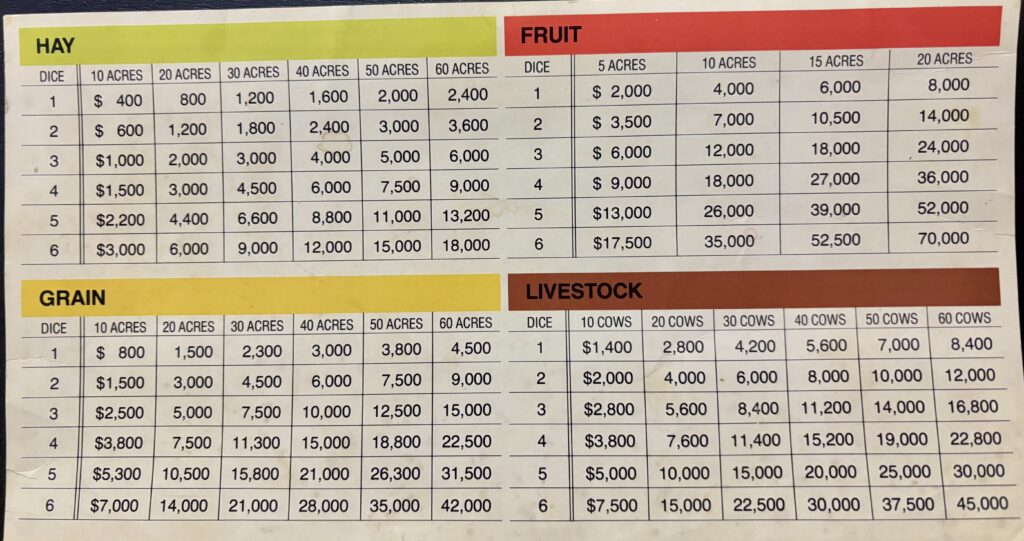
In my mind I imagine fruit was a magical crop to George as he rode around on his tractor. There is no card that decimates your fruit acres and there is little doubt that going all in on cherries and apples is often the key to success. In real life I believe there is a bit more risk involved on the fruit side and I don’t actually think apples are the cash crop George envisioned. Or maybe in 1979 that’s how things were in Washington state.
During our three hour playthrough I had a great time. It is random and silly and the first half of the game is a crushing debt minefield. I didn’t win but I had 25 acres of fruit and needed one more mediocre harvest to be in the running. I’m not sure if everyone else at the table enjoyed it as much as me but there were definitely some laughs and celebrations when multiple Uncle Berts died and left us an inheritance.


4 responses to “Farming (Game) In Portugal”
Playing in October???
We certainly could, but there might be better options. We’ll see!
I play 500 every Wednesday at our local community center. I love this card game, I did not know it was Australia’s national game. You are a wealth of information. Love, Aunt Peggy
I’ve never ran into someone outside the family who played 500. Grandpa and I would always partner up and go for extra aggressive bids, usually getting beat by grandma and M (who would both be a bit more reasonable). I don’t regret any of those bids!
If you have a group who loves 500 I highly recommend trying Tichu, M and my favorite trick taking game.