
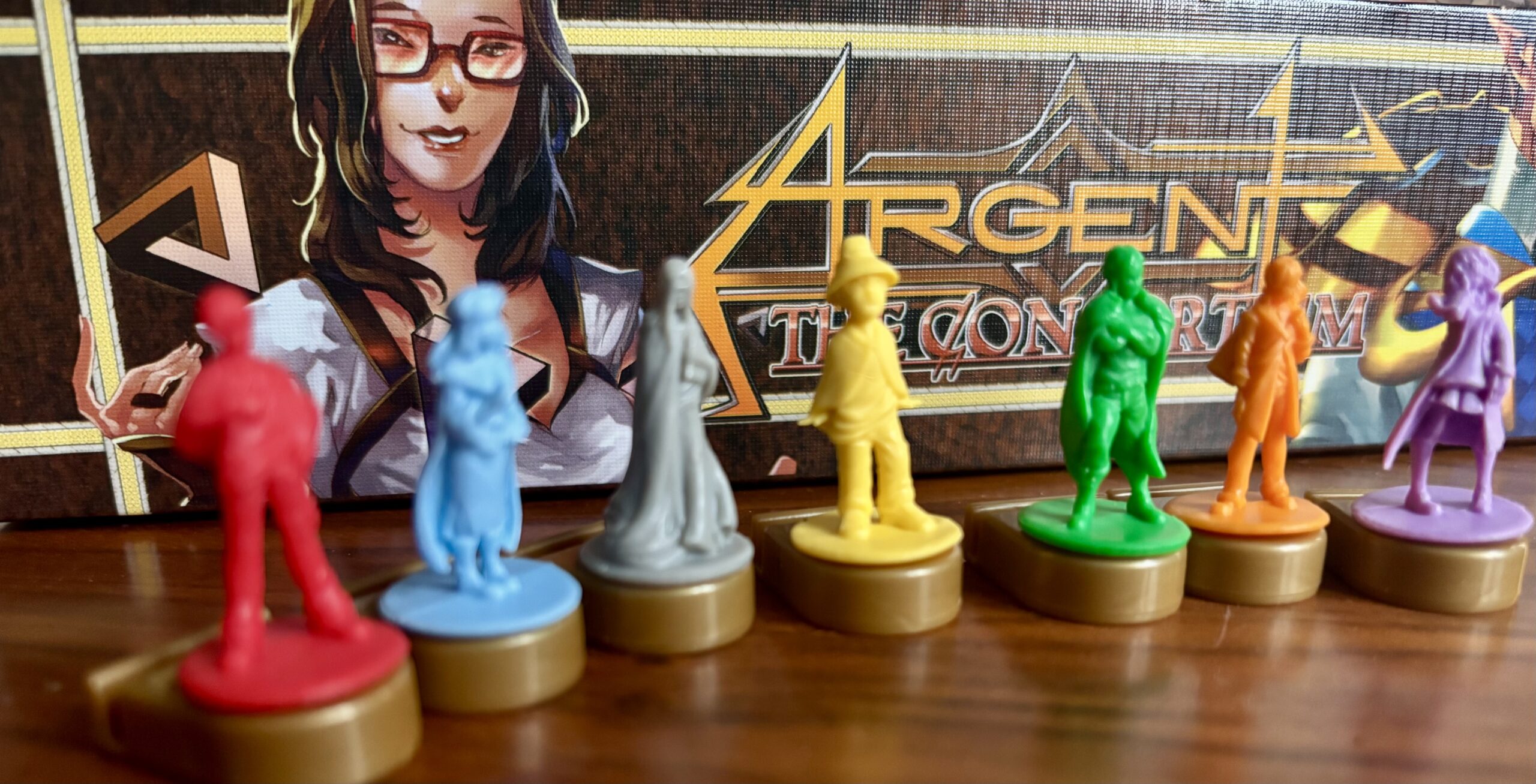
Today I’m going to talk about one of our favorite board games, Argent: The Consortium, in which players battle to win the most votes and become the new chancellor at the magic university where you all work. Don’t run out and buy the game yet, I have a lot to say about Argent and depending what type of witch or wizard you are, it may not be your cup of tea.
The chancellor at Argent University has announced their upcoming retirement in exactly one week and the game takes place during that time. Each player is a candidate vying for this coveted position and needs to win the most votes by the end of the game to secure the job. Instead of dealing with applications and interviews a secret group of twelve voters has been assembled, called The Consortium, and each of them will cast one vote for their candidate of choice when the week is up. Each voter has one criteria which they will base their vote on so the players’ goals appear to be pretty straight forward… except ten of the voters are hidden when the game starts and each player only knows what three of the twelve voting criteria are.
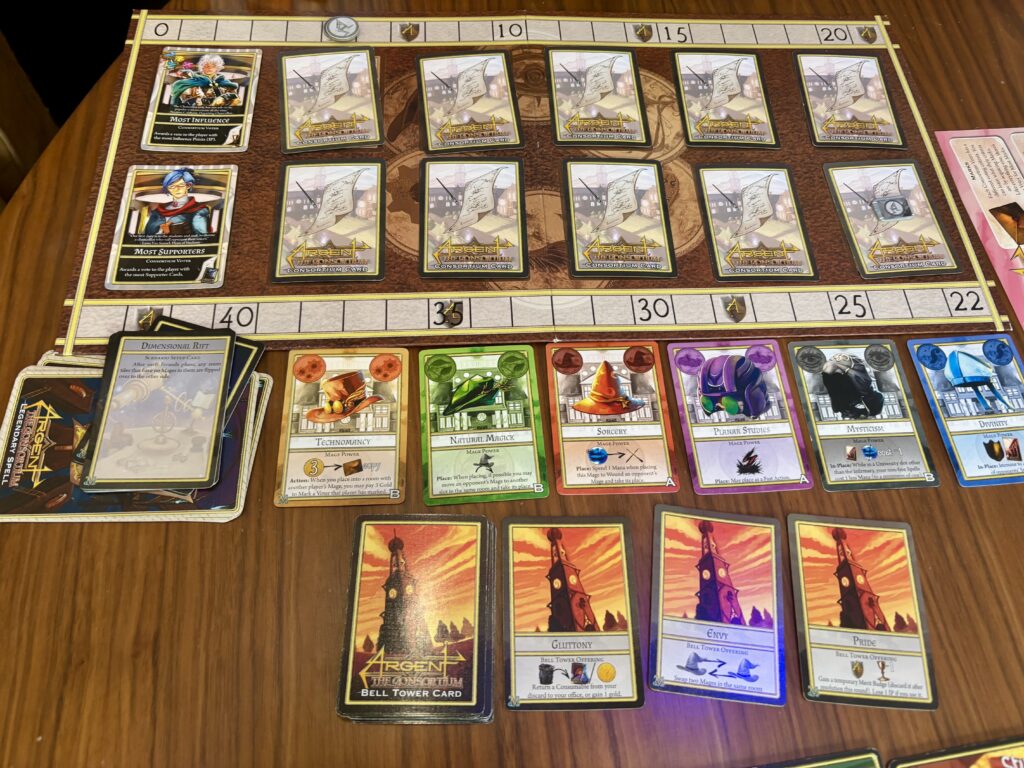
Each player selects a school of magic (there are six available in the base game plus one from the expansion Mancers of the University) and gets two mages from their school who will take the actions on your behalf, a unique spell from that school, some money, mana (used to cast spells), intelligence (used to learn new spells), and wisdom (used to make spells more powerful. Players will then draft three additional mages from other schools of magic (for a total of five) and get to peek at one of the hidden voters.
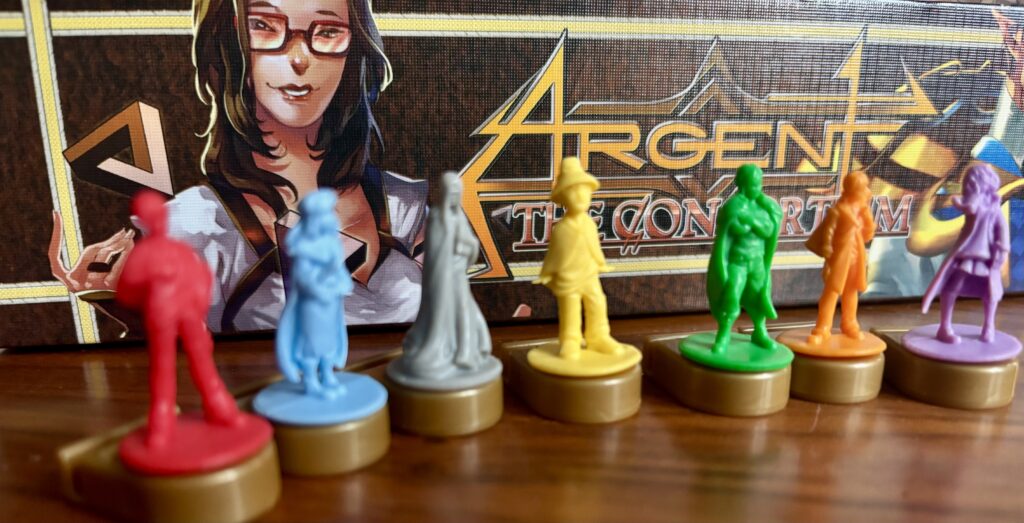
Argent is a worker placement game, which may be an unfamiliar type of board game if you aren’t an avid player. In this type of game you have workers (or mages in Argent) who you send out to specific spots on the gameboard on your turn to decide what action(s) you get to take. Normally the spots only allow a single worker so it is important to claim the ones most important to your game strategy first. Imagine a game where you want to buy seeds, grow seeds, and then sell vegetables to get money which is what you need to win the game. It’s the first turn and you put your worker on the spot to sell vegetables, this would be a mistake because you don’t have anything to actually sell yet and your turn was wasted.
In Argent there are two important twists to this basic formula. First, your mages don’t get the benefit of the spots they are sent to until the end of the round and they only get that benefit if they are still there when that happens. Second, each type of mage has an inherent power, for example a red mage can pay a mana to boot another player off the spot they are in and take their place. Going back to our vegetable game, imagine that you had three workers who (in order) will buy seeds, grow them, then sell the vegetables but I then use a red mage to take the spot where you planned to buy seeds. You lost that action but now both of your other actions are also wasted that turn!
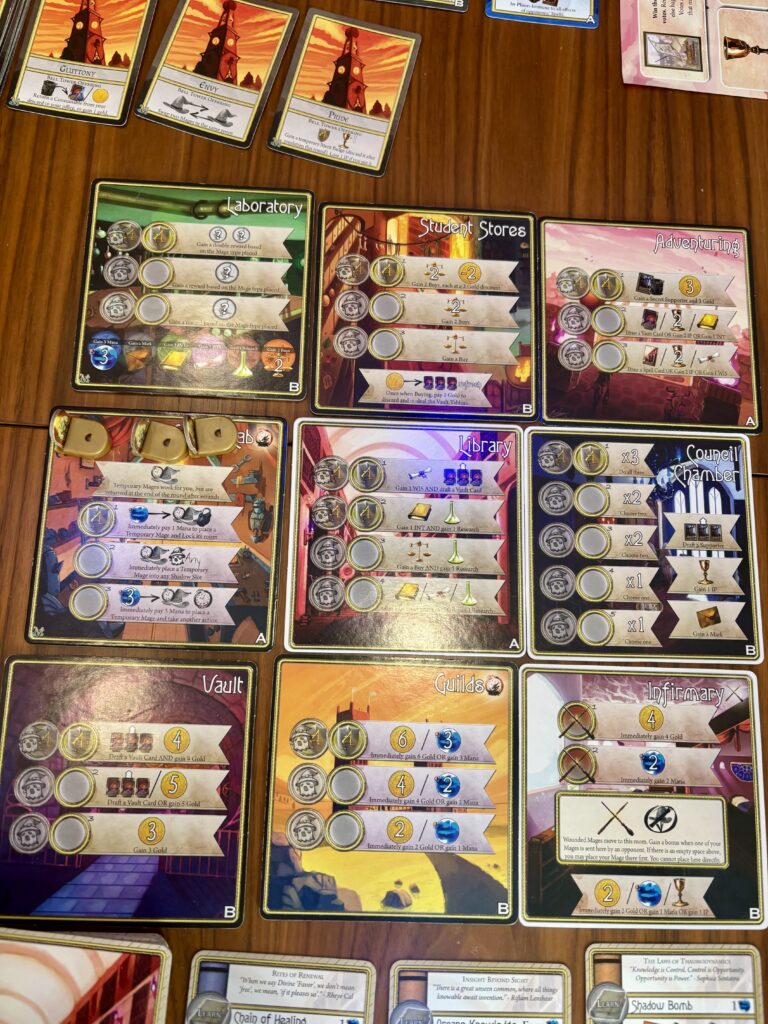
All this may sound complicated but an actual turn in Argent is straightforward, you can take a fast action and must do a single errand. Then the next player has the same options and this goes round until players have passed (not doing an errands) a certain number of times which is based on player count. Passing ends a player’s turn, but also gives them a Bell Card which grants an immediate bonus.
Errands include sending your mages to the various spots available, casting a spell, using cards you’ve collected during the game, or passing and taking a Bell Card. Fast Actions are special errands that are clearly marked with a specific lightning bolt symbol.
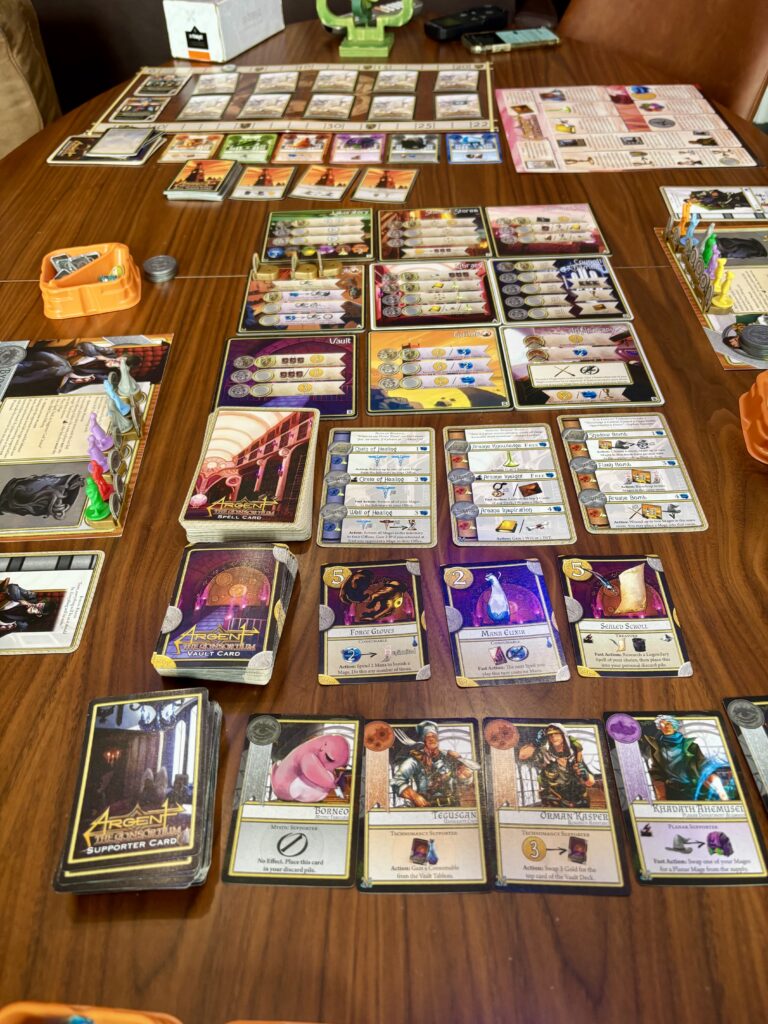
After enough players have passed, the round ends with all the mages doing the actions listed on their spots one at a time in order. In a normal game there are five rounds, after which the voters are revealed and points are awarded, deciding who the new chancellor is.
In addition to the very fun theme that is thoroughly incorporated into every part of Argent there are a few other things that keep us coming back for more. First I’m going to talk about variety and replayability.
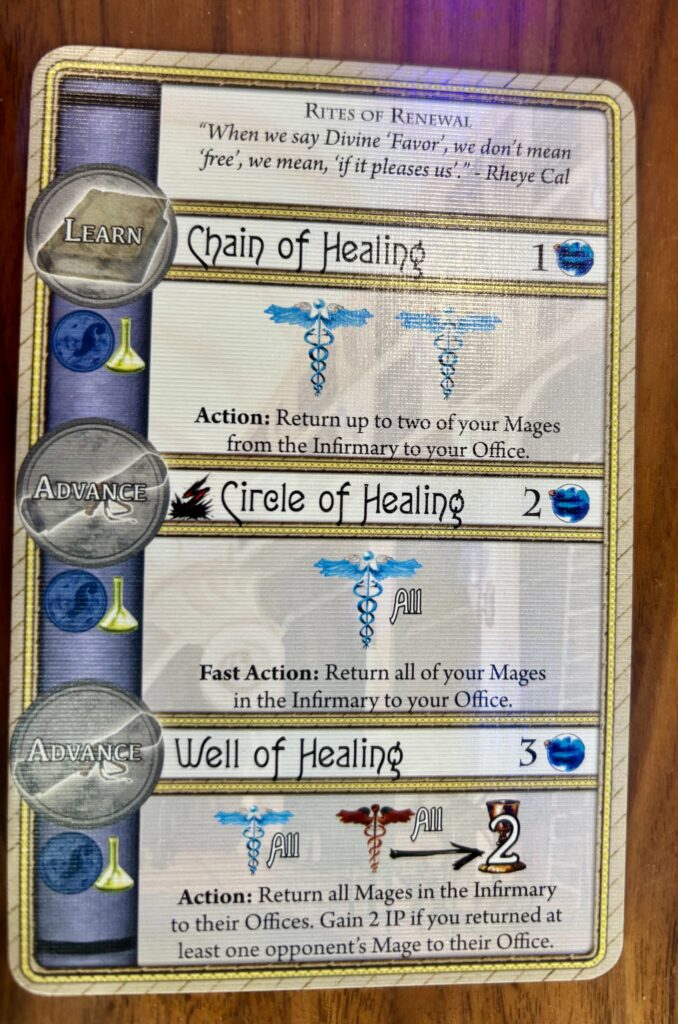
Argent doesn’t use a traditional “board” for the play area, instead it is a randomized set of rooms that are decided at the beginning of the game. In a two player game you use nine out of twenty possible rooms and every single one has two different sides you can choose between. The rooms chosen for a game make a massive difference in how players will go about achieving their goals which means you can never settle into one specific strategy.
Additionally, each of the seven starting schools of magic has two options, each with a different starting spell. Each of the six main mage types have two different options for what their special power will be (the yellow mages don’t have a special power). Each round the spells, items, and supporters available to the players is chosen randomly. Even the bell cards have random benefits, especially if you are using the expansion. You can never go into a game of Argent expecting a certain combination of things to happen, winning will always rely on your ability to go with the flow and adapt.
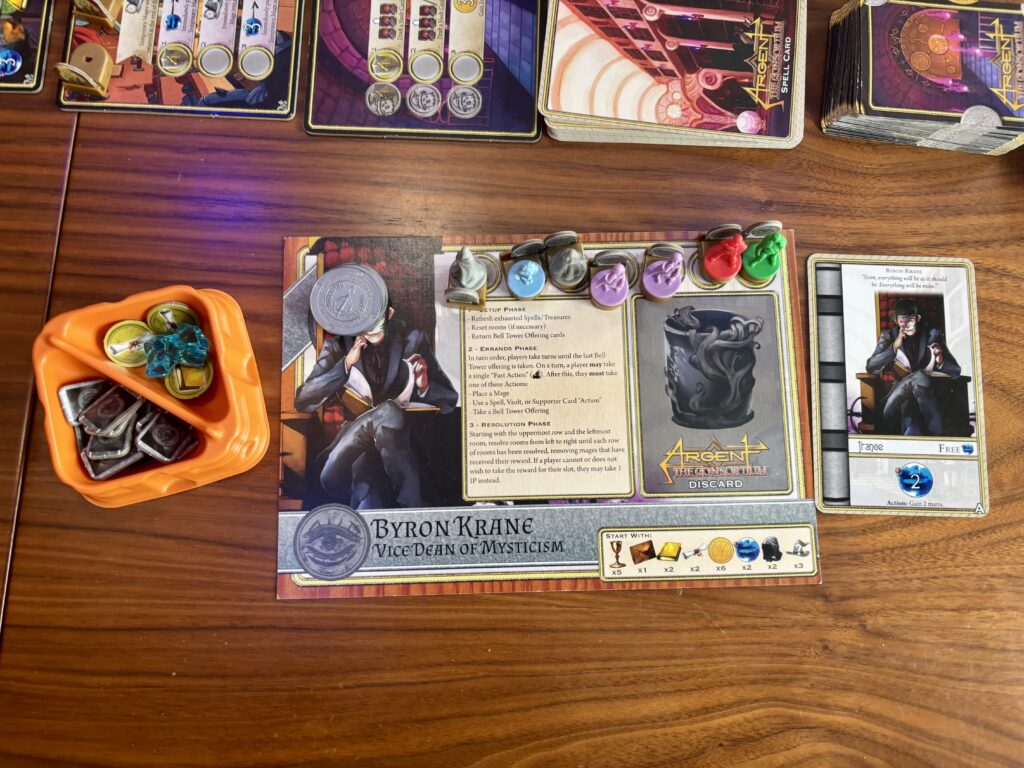
The next thing we love is the pure zaniness of the game. Things start calm with only a few fights for different rooms in the first round but by the fourth round spells are flying and players are taking an insane amount of actions each round. But, because of how the players build up incrementally round by round the game doesn’t normally feel as overwhelming as it can appear to an observer.
Argent also has a mechanic which allows adept players to have more basic options as the game moves forward. First, players can earn merit badges, each of which allows them to put a single mage into the most powerful spots in each room. Since these badges are limited, those spots aren’t always as contested. Additionally, almost every spot has a shadow placement only accessible to players who gain the appropriate spells or items as the game progresses. By using these alternate placement options a player can almost totally avoid conflict in the second half of the game (at least while placing their mages).
A final thing I’ll mention in favor of Argent is that it allows players to strategically use the possibility of attacks without forcing their hand. Most games (because I play with nice people) don’t devolve into complete aggressive chaos, but they could at any moment. It provides the possibility of an excellent balancing of threats and attacks.
Two basic downsides to the game are space and time. A four player game will easily take four hours if even one player is learning how to play. Even a two player game will cover a large table.
The other significant drawback for some players is that Argent has a lot of moving parts and, even though they all make sense individually, the amount of information a player has to keep track of might be a challenge. By the end of my last game I had 15 spells and about 15 items that I could use on my turns, plus seven mages to send out on errands. Some of my options let me reuse items from my discard pile or even use my opponent’s items. It was excellent, but much more involved than a mid difficulty game.
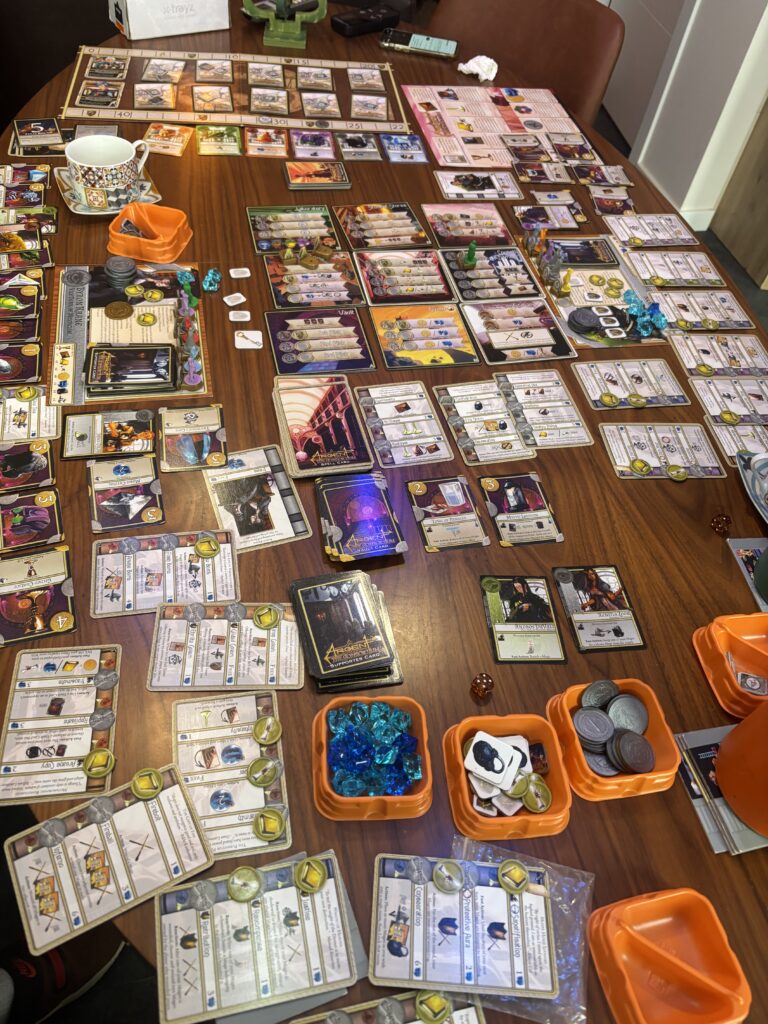
My final gripe is that, because of its size and time commitment, almost every game we have played of Argent includes players who are new to the game. Because of that we have played the basic game setup during about 90% of our plays. While writing this review we tried a two player game for the first time and realized it worked great and now we are kicking ourselves for not playing more games with the two of us so we could experiment with the more complicated options.
If your game group likes the wizard theme, enjoys replaying games and tactical decisions, and doesn’t mind the potential for player conflict I can’t recommend Argent enough!


2 responses to “I Want To Be The Head Wizard In Charge!”
This is what I admire the most about both of you. The well rounded choices of life. Exercise, cooking, decorating, baking, playing actual board games, crafting, entertaining, going to concerts, sporting events, traveling, reading, watching films and T.V. Taking the time to stay in touch. I adore you both. Love, Aunt, Peggy
Thanks so much Aunt Peggy! We try to just do what we enjoy and it leads us to so many fun places.