
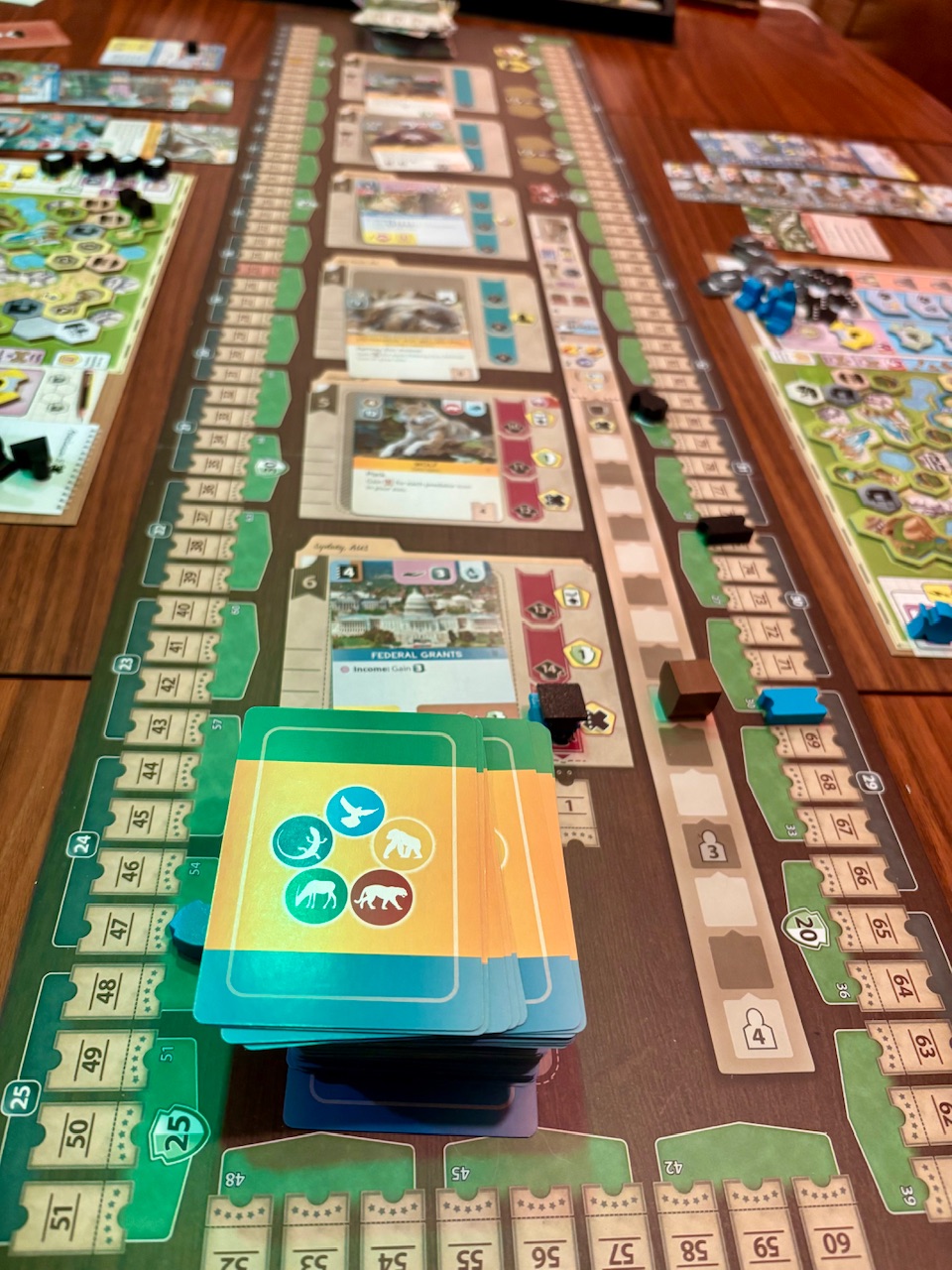

In reality building and running a zoo seems like a nightmare to most people, except maybe Matt Damon and a handful of zoologists. Today I hope to tell you how the experience translates into a board game, specifically Ark Nova. Released in 2021 by first time developer Mathias Wigge and currently rated as the #2 game on BoardGameGeek. Is this fairly heavy (3.79/5 complexity) game one you should add to your collection?
Just before moving, Michelle and I were at our local game store in Ashland trying to find the right game to pack and bring with us to Portugal. Ark Nova was featured because it was a new release with a lot of hype on BGG and it caught our attention because of the interesting theme. We definitely didn’t have any games in our collection about building a zoo. For that purpose we made the right choice and chose Gloomhaven: Jaws of the Lion instead. Having a cooperative game that offered a huge amount of playtime was exactly what we needed while settling into our new life. This year we finally came full circle and added Ark Nova to our collection as one of our birthday board games.

In Ark Nova each player will “plan and build a modern, scientifically managed zoo” and the player whose design has the highest combination of appeal and completed conservation projects will win. I’m going to summarize the rules and mechanics which will take awhile but bear 🐻 with me because this is a zoo worth buying!
Setup
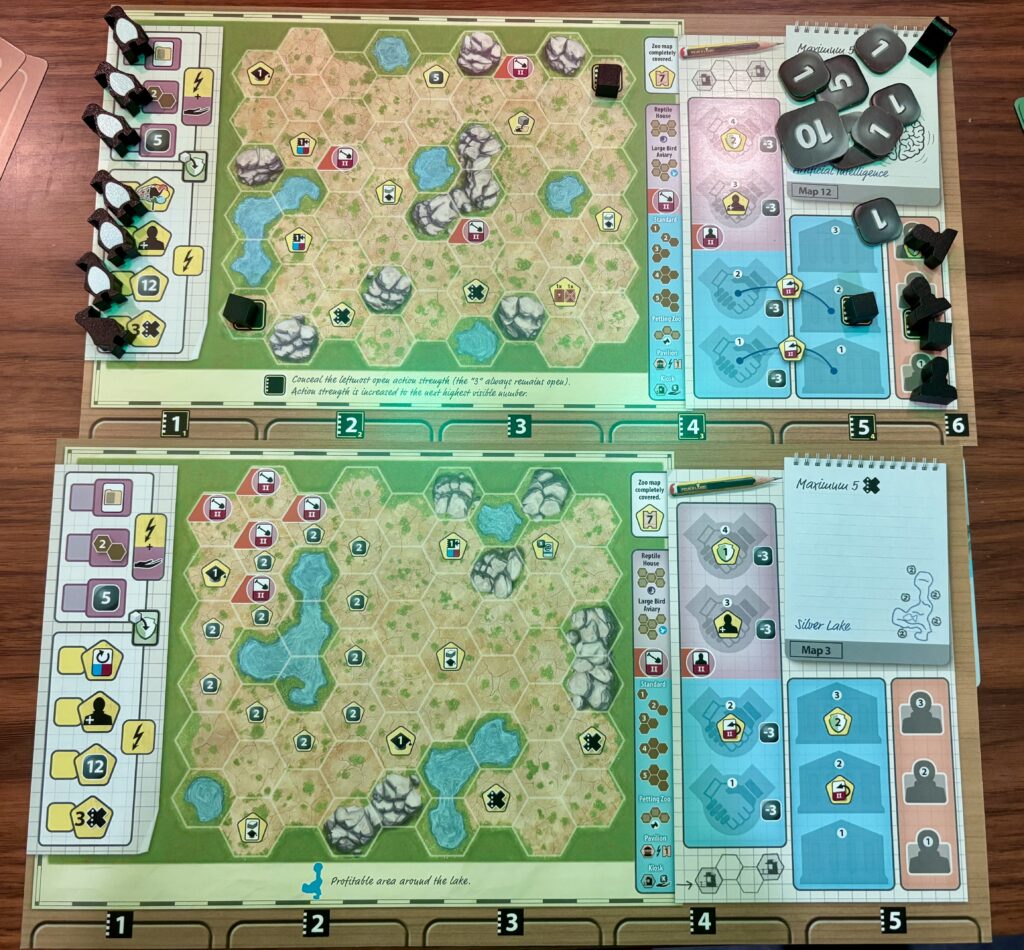
Each player gets a zoo map that they will be filling with enclosures which will then house different animals. The map is also a player mat and holds your zoo workers, money, partner zoos, universities, and tracks completed conservation projects rewards. This is actually the first choice in the game as each player will get two potential zoo layouts with different bonuses which they must choose between.
There is also a very large game board which holds the shuffled deck of zoo cards (over 200 cards featuring animals, sponsors, and conservation projects) and displays six of those cards face up which players have access to when drawing. This board also displays each zoo’s appeal, conservation points, and reputation. There is also a coffee cup meeple on a break track that moves up during different actions (representing the passing of time) which triggers “break time” when it reaches the end of that track – more on this later.
A final smaller board called the Association Board organizes available options for the associated action. These include universities and global zoos to partner with and the available conservation projects.
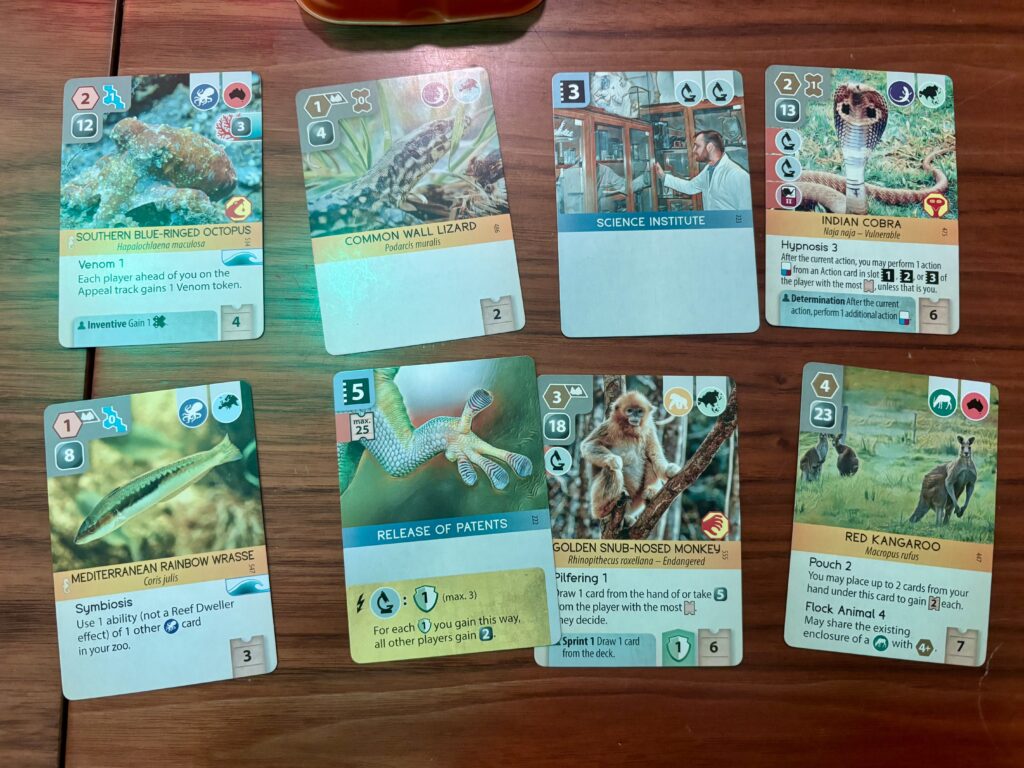
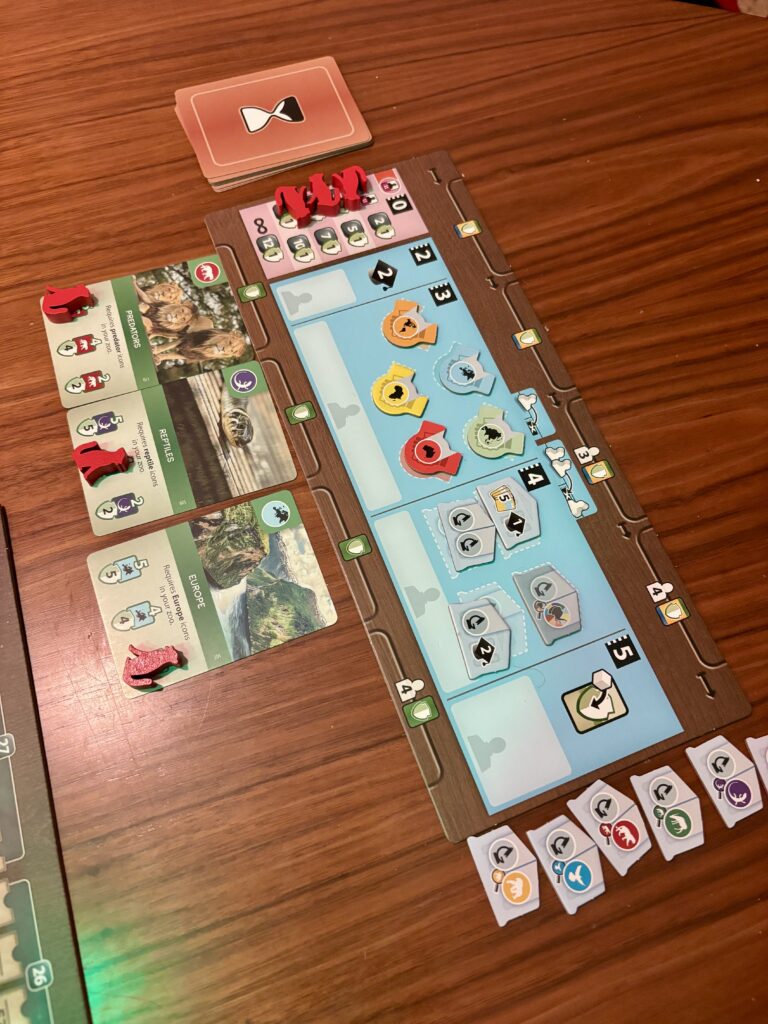
Before the game begins each player gets four workers (one active) two end game scoring cards, 25 money, 5 action cards, and 8 zoo cards. The second major decision happens now as players must immediately discard 4 cards from their starting 8.
Objectives
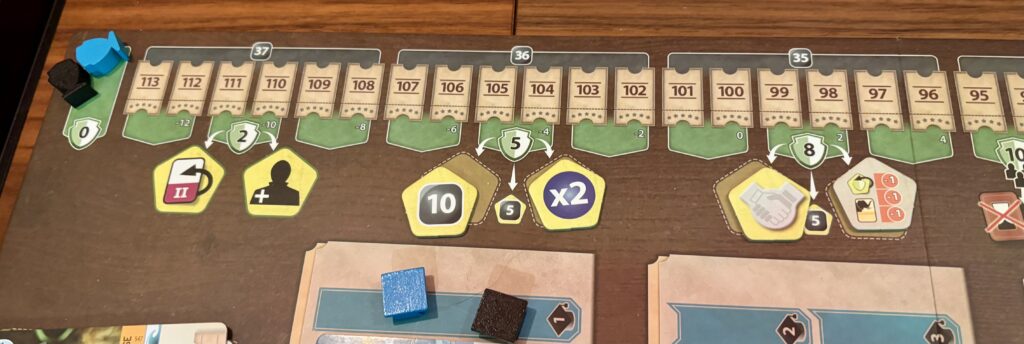
Now that we are ready to play let’s talk about what your goals are. The game tracks appeal and conservation on two tracks that start on opposite sides of the game board and will eventually meet somewhere in the center. When a player’s score trackers meet or pass each other there is normally a final round and then scores are totaled to decide the winner. In addition to the score tracks that go up throughout the game, players will have one end game scoring card and multiple other cards which may give bonus points.
One of the first things that sets Ark Nova apart is that the various tracks and scoring opportunities give players various bonuses in addition to endgame points. The appeal track is the simplest – the higher on this track your zoo ranks, the more money you get during break time. The conservation track offers three bonuses as you start getting points and you also get significant bonuses each time you support a conversation project.
The final track which I briefly mentioned has to do with your zoo’s reputation. Although this doesn’t give you endgame points, it runs along the line of six face up cards on the game board. When you draw cards you can choose not just from the deck, but also from any of the cards you’ve reached on that track. High reputation also leads to other significant one time bonuses. This flexibility is important because by default every time that break time occurs you must discard down to only three cards in your hand. You can plan ahead if you see a desired card coming down the reputation track, just be careful that someone else doesn’t grab it first!
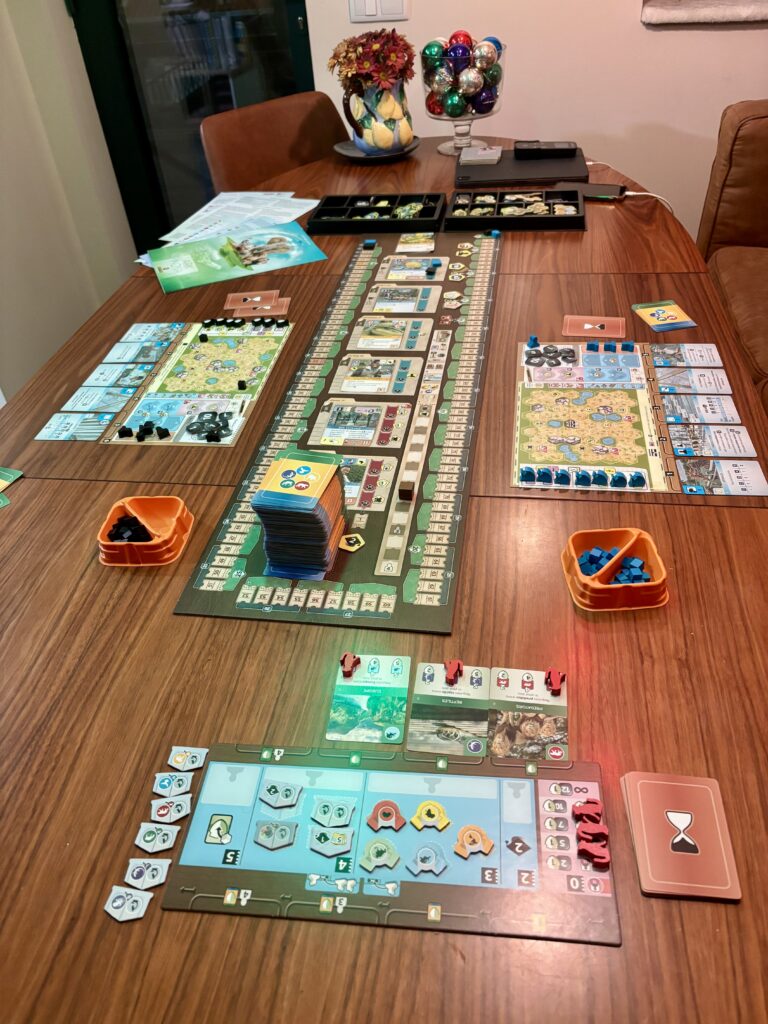
Gameplay
Every player starts with five action cards on their level one side: Build, Cards, Animals, Association, and Sponsors. Under your player board there are slots marked 1-5 to place these cards (at the start of the game Animals goes in slot 1 and the other four are randomized). Each turn you will choose one of the five actions to do and then move that action card to slot 1 and any other cards that were in a lower slot up one apiece. So if I do the action in slot 4 the cards that had been in 1, 2, and 3 will each move up one slot. The slots are significant in that each card’s action gets stronger the higher it is when you play it. If you truly don’t want to play any of your action cards you can pass, gain an “X Token”, and choose any card to move into slot 1 (sliding lower cards up one slot apiece). X tokens can be played when choosing an action card to increase the power by 1 slot per token played.
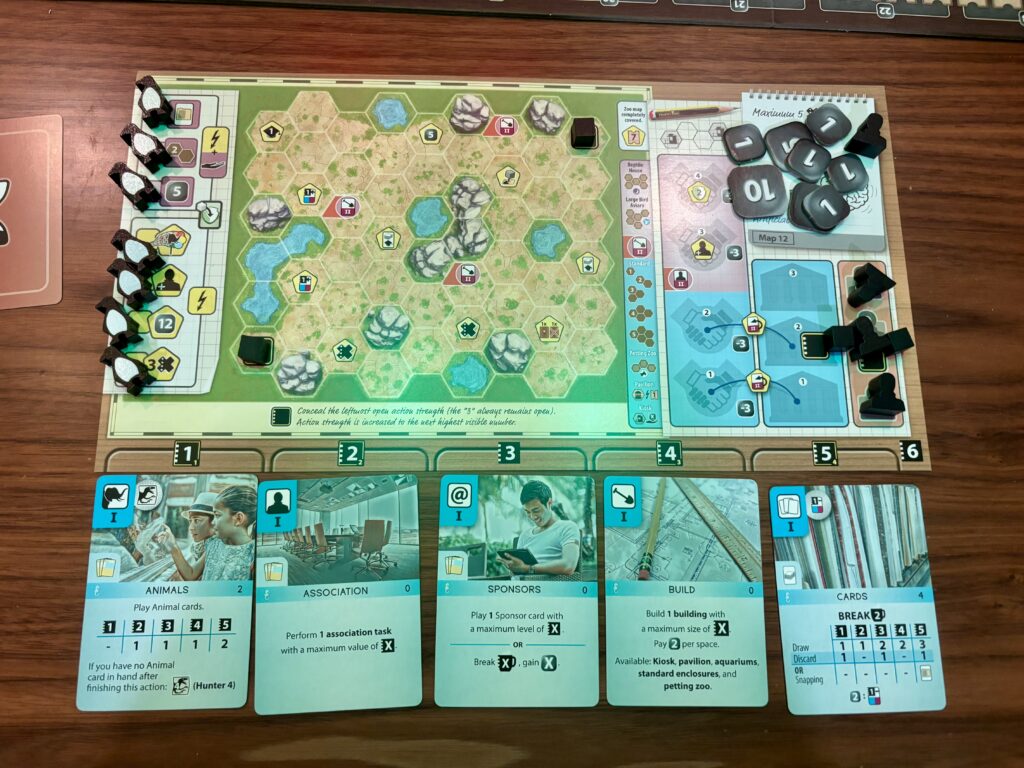
During the game each player can potentially upgrade up to four of their action cards to level 2 which makes their associated actions significantly stronger. Let’s look at the actions!
The Actions
- Build: Animals in your zoo need a place to live and this allows you to build those enclosures. The higher the level when played the bigger the enclosure you can build. In addition to enclosures that are size 1-5 you can also build a petting zoo or various money making structures. After paying for your chosen building you immediately add it to your zoo and gain any bonuses it covers up on your zoo map. At card level 2 you can build multiple structures during a single action and have access to some specialty enclosures for birds and reptiles.
- Cards: This is how you normally add cards into your hand. The higher the level the more cards you draw from the deck. At high levels you can “snap” cards which means you take any single card from the game board. At card level 2 you can now draw cards from the player board in your reputation range and get to draw more cards.
- Animals: Once you have an appropriate enclosure you can play animal cards from your hand to add them into your zoo. Animals can have multiple requirements including animals types, affiliations with specific continents, specific enclosures, cost, and environmental needs (water or rocks) to name a few. At card level 2 this action allows you to add some elite animals to your zoo and play cards from directly within your reputation range for a small fee. Animals almost always add appeal to your zoo along with other benefits and bonuses.
- Associations: Here you can send your available workers to the association board to partner with other zoos and universities, gain reputation, or complete conservation projects. At card level 2 you can complete multiple association actions and make monetary donations to directly increase your conservation level. You can also play conservation projects from within your reputation range.
- Sponsors: The final action lets you play sponsor cards with a value up to the level of the action. Alternatively you can increase the break marker and gain money equal to the level you play the card at. Sponsor cards are all different things and people you might find in a zoo and give a wide variety of benefits including additional income and endgame points. At card level 2 you can play multiple sponsors and have access to some elite sponsorships which can’t be played at card level 1. You may also play sponsor cards directly from within your reputation range.
Other Gameplay
When the break token reaches the end of the track the player who moved it gets an X token and then six different things happen. Most importantly you must discard down to the card hand limit, get your workers back to use again, remove two cards from the display and replace them, and finally gain income from all sources.
There are obviously other rules which I haven’t covered but they are clearly laid out in the 20 page rulebook. There is also a two sided icon guide and a separate glossary which details individual cards and other unique aspects of the game. I’ve taught the game multiple times now including to a casual gamer and everyone has understood how things work quickly. I think a big part of this is that everything thematically makes sense and is presented with clear iconography and card explanations.
I have played with 2, 3, and 4 players and enjoyed every game so far but at four players the game does take a long time, especially if you are also teaching it during that session. You’ve probably caught the hint that I really enjoy Ark Nova, but let me break down a couple more things about it that really stand out.
Analysis Paralysis and Complexity
A game this complex can break if you have a player who constantly weighs every decision. The design of Ark Nova works to prevent this and keep things snappy in multiple ways. First, the small hand size means that you can’t stockpile 20 cards, when break time rolls around you need to toss out all those extra options. This means I’m constantly keeping track of what is important in my hand and can keeps players focused on a plan.
Next, of the five actions some just aren’t going to make sense at any given time. If you don’t have any money you can’t build or add animals. You only have a few workers who can be sent off to the association board and hand size also limits available sponsors. Most significantly, players will strive to use the highest power action when possible and avoid actions in the first couple slots.
All of those design decisions and more take a massive number of variables and make them manageable to a non-gamer or player who suffers from analysis paralysis.
Strategy versus tactics balance.
Although there are definitely mid and long term goals each player will have in Ark Nova, this is a game about tactics and thinking on your feet. It is about eking out the most from your limited resources while avoiding having to constantly push for break time or use sponsor actions to gain a quick buck. You must use the cards you draw efficiently and pick and choose when to grab or play display cards. Some cards do benefit or even require others to function, this game is not about building an engine or making repeatable card combinations.
Ark Nova is a game about timing things right and building towards having more flexibility during the mid game so you can outscore your opponents in the final stretch. Remember how you start with 8 cards and choose 4 to keep before the game even starts? This choice is representative of the game as a whole. You will very likely have an amazing animal in those first 8 cards! That animal will likely require a leveled up animal action card, a pile of money bigger then you have available, multiple associations with a specific continent, and probably other animals of the same type as the amazing one you want to play. And, don’t forget you probably need a large enclosure near rocks or a body of water. You need to overcome temptation and throw that card away, keeping instead a smelly goat for the affordable petting zoo you can build right away.
Wait, there is actually more! New players, Marine Worlds and Map Pack 2.
I mentioned during set up that each player gets to pick from two map options. There are actually two maps (with four copies of each one) which offer significant advantages to new players. This takes away the sting when playing your first game and makes some of the early game choices much easier.
We also purchased two expansions and they are both mixed in with our game. Map Pack 2 adds five new map options including four copies of a tournament map for people who want a balanced challenge without using the new player maps. These maps don’t impact the overall rules and can be incorporated with little effort.
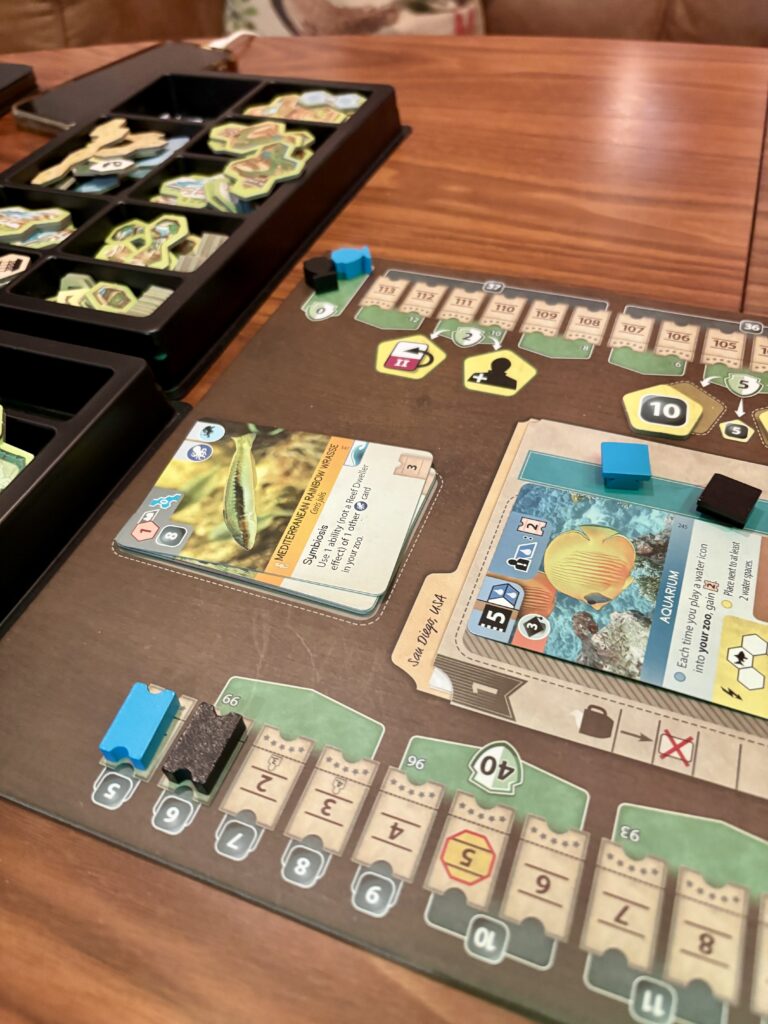
The first full expansion to the game is Marine Worlds which adds a new animal type, enclosure (aquariums), new zoo cards, updates to existing zoo cards, cute tokens to replace conservation and score markers, and variable action cards. There are 20 new action cards (4 for each action) that add a slight twist to the basic actions. At the start of the game players get to choose two of those new cards to replace their normal actions via a drafting mechanism. Although we’ve only played one round with the expansion, it didn’t add much complexity but did add fun, and even more variety to an already diverse game.
Final Thoughts
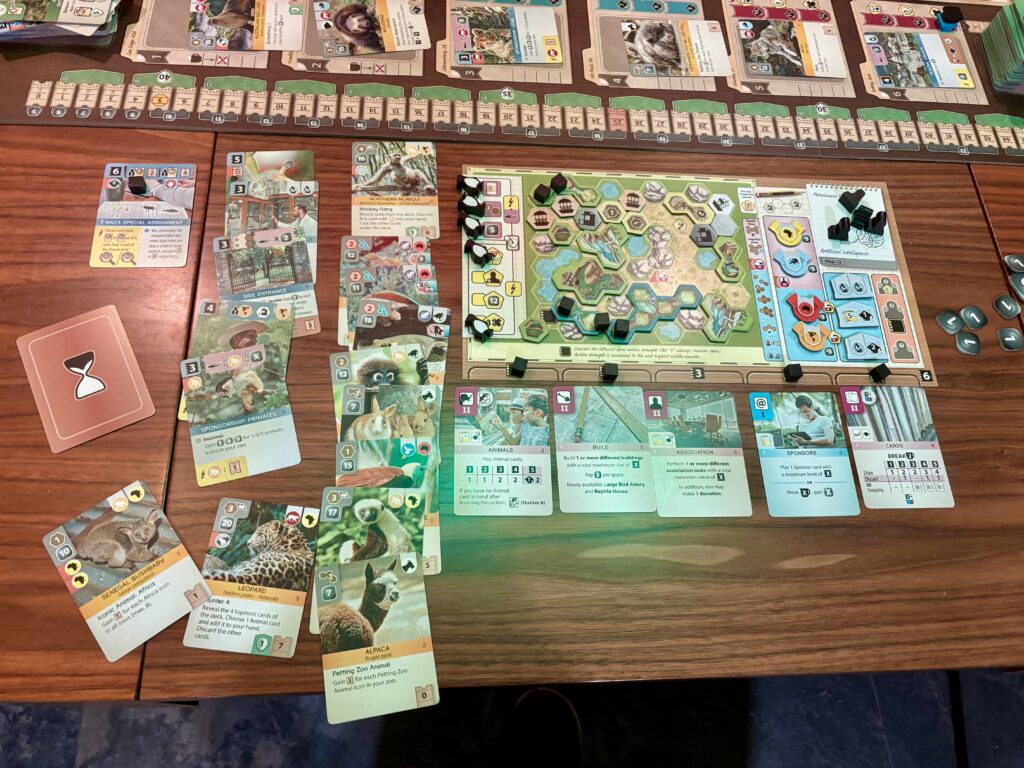
Should you add Ark Nova to your collection? I know the game includes a solo mode but, setting that aside, my first criteria would be that you have at least 1-3 other people who will join you at the table to enjoy this complex game. If your uncle visits to play Checkers every week this would probably be too much of a jump up in difficulty and I’d recommend something simpler first. You need quite a bit of table space, as much or more than even Gloomhaven. Even if you aren’t great at learning by reading rulebooks there are a plethora of how to play videos and guides available online so don’t let that stop you, however, you need to be comfortable enough to reference the rulebook and glossary to check rules as you play – or have someone in your gaming group who can take on that role.
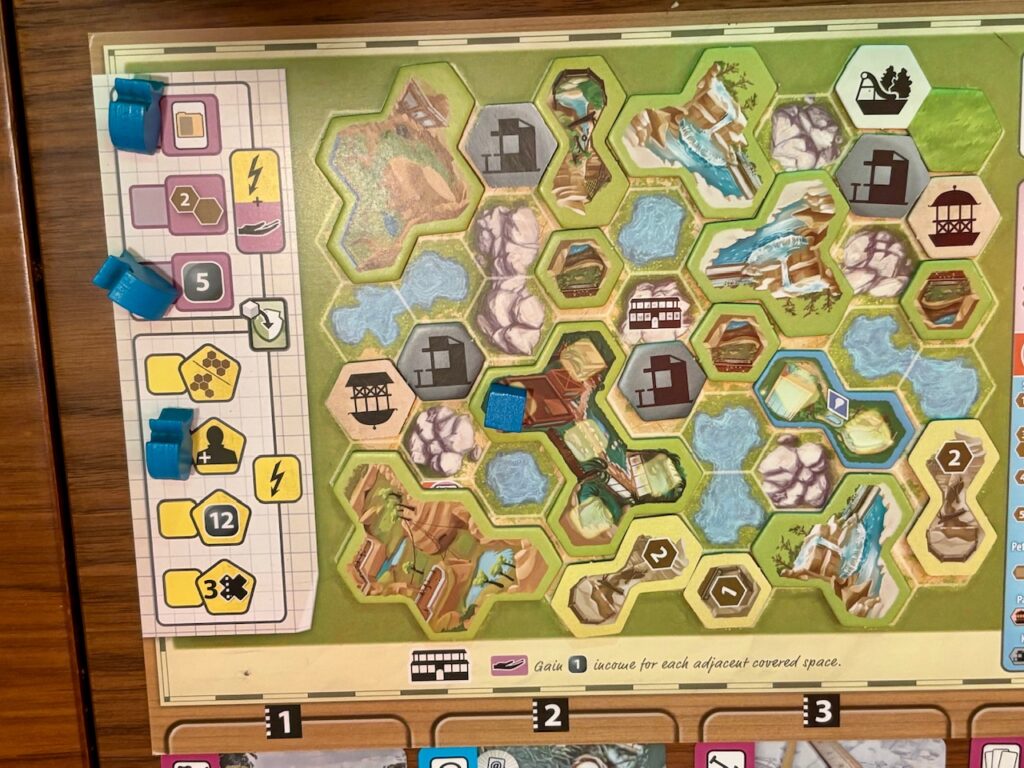
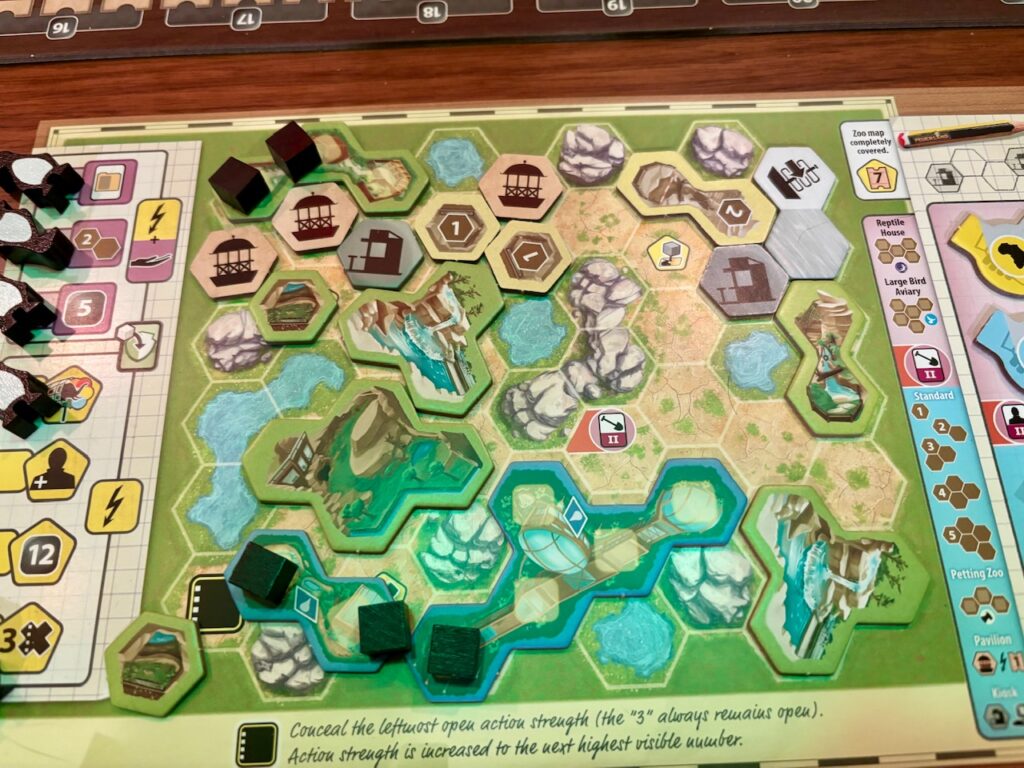
Outside those few situations I think the answer is a resounding YES. I foresee many more plays of Ark Nova in my and Michelle’s future and I can definitely tell you that I haven’t even scratched the surface of potential strategies and tactics that the game has to offer.
As always, post any questions in the comments. If this isn’t the game for you, but you are looking for something else, describe it and I can try to make a recommendation!


4 responses to “Ark Nova: A Zoo Building Boardgame”
Now if you could do what you just did for Decrypto!
Hmmm, I’m contemplating the Decrypto idea, not sure if I’d have to pair that with a few other games to break it down.
Did you buy that huge table in Portugal? Is it wood? I love it. Aunt Peggy
It is wood and we love it too. We got it here in Portugal at the store when we were upgrading our pellet stove. The expandability is perfect for games or big gatherings and the round corners allow it to fit in our dining area.