
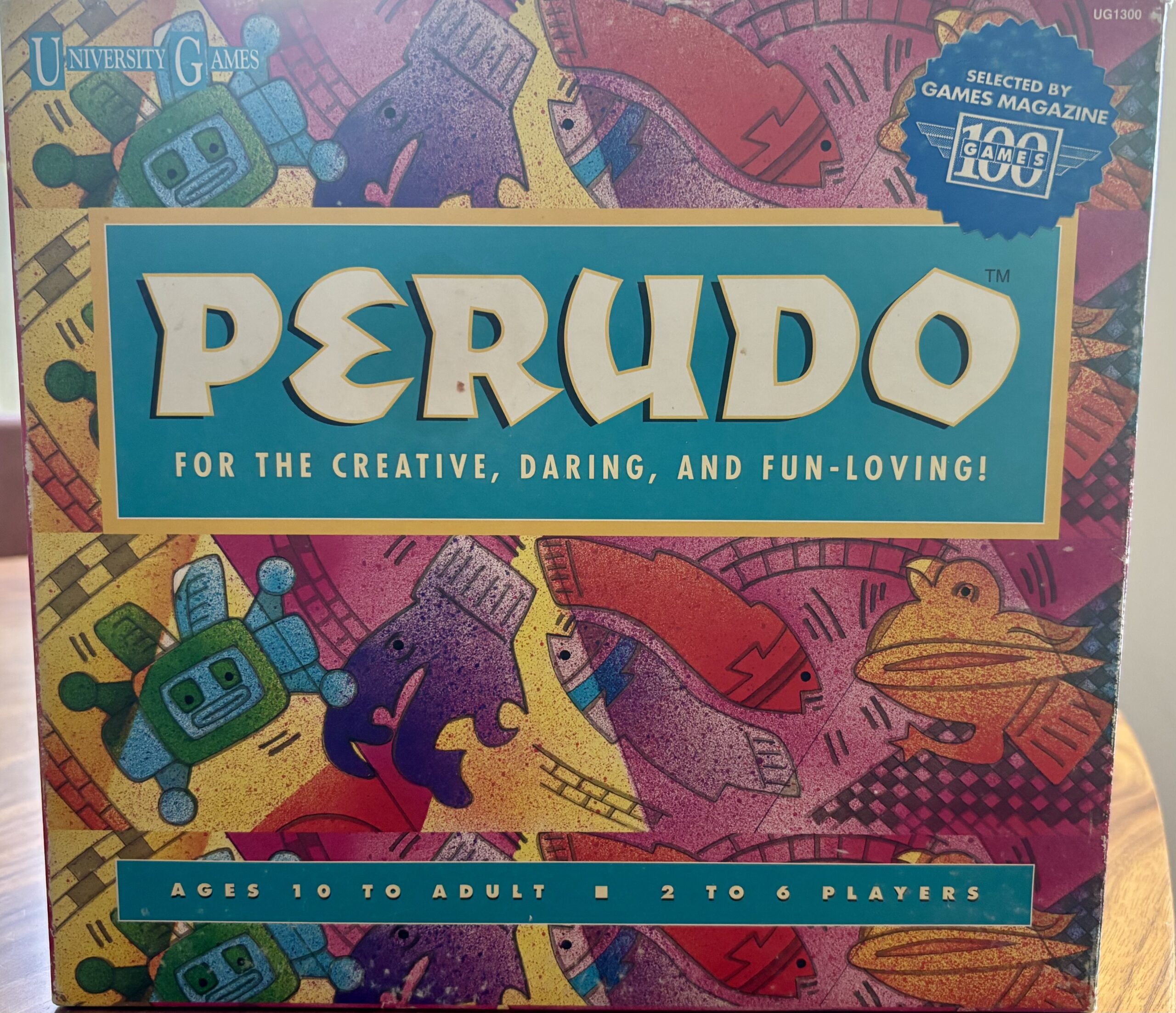
Back in the late 90’s I used to have house parties that involved lots of party games. My friendship with Michelle solidified during these nights in spite of the fact that they were chaos filled drunken nights that got progressively zanier as my move away from Minnesota approached. We lived in a college community and my apartment featured a free roaming hedgehog, a non functioning blue bicycle that I had found abandoned in the middle of the roadway, and a lot of young bachelor messiness.
This era was before the two of us discovered the modern boardgaming renaissance. My games were primarily those that I had played growing up at family gatherings which I then added to my collection as a young adult. Taboo and Boggle were always hits at my grandparents’ house, Talkin’ Tango usually incites some laughter, Beyond Balderdash and Malarky are a style of game not currently very popular (one of those games even inspired me to get a tattoo), and Skip Bo has always been too long but is easy to play after five shots of vodka. We still own most of these games, but most of them don’t come to the table very often.
Somehow I had also acquired Perudo, commonly known as Liar’s Dice or Bluff. Of all the games we played back then, this is the one that has stood the test of time and we play it 3-4 times almost every year. Thankfully it’s just as fun sober and works great with a group of 5-8 players, but we’ve managed games with even a dozen people and the game is still plenty of fun.
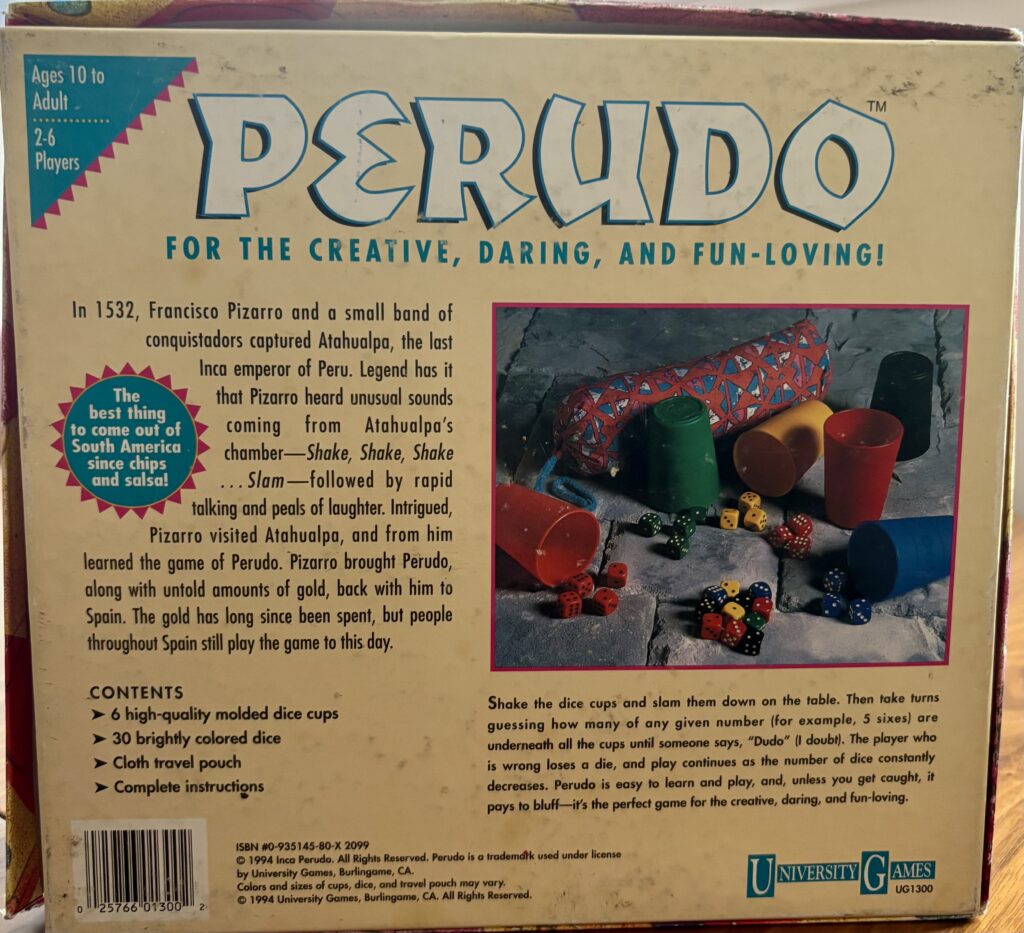
I’m going to provide a quick tutorial video, then talk about the pros and cons of the game and finally provide a couple variants you could use to spice up gameplay if you want.
You are probably wondering, what could anyone possibly complain about? This sounds like a perfect game! Unfortunately some people just like to complain. Dudo! There are a few legitimate gripes people could have against Perudo. It is a player elimination game so if someone is very bad at the game they could be out early and just have to watch the remainder of the game. If you play with more than six players the game can go a little long, especially if the players aren’t making their bids quickly. Sitting by a player who is good at the game can be a major disadvantage. Finally, nobody can remember the word dudo for some reason.
Why do I think Perudo is a game that will always be in my collection? It is extremely versatile and portable, working with a variety of skill levels and player counts. If you have ten cups and fifty dice (who doesn’t?) and don’t want a long game, play in two groups of five. The game plays fast and until a person is eliminated they get to participate in multiple bidding actions with almost no down time. I always encourage a celebration of someone becoming a Palifico so even if a player is having a bad round they get a little party before they get eliminated.
Most importantly, Perudo manages to tell a story even within the confines of its simplicity. The first part of the game is about statistical probability, one third of the dice will probably equal the bid value plus ones, but a player can use luck and the information they get from other players’ bids to outplay the math and win improbable bids. Once a player has become a Palifico the game changes to a party of victories and losses, of underdogs with only one or two dice fighting back against those tyrants who haven’t even lost a single die. It’s this spur of the moment storytelling that usually minimizes the impact of an elimination – those players often want to stay nearby and cheer on other underdogs or the person who took their last dice. The final act is the duel. Perudo in and of itself wouldn’t be very fun with just two players because you have too much information. That doesn’t mean the mechanics don’t work with only two. At two players it is perfectly clear why the game is sometimes called Liar’s Dice as bluffing and misdirection become clutch skills needed to win.
There are a couple variants in the different rulesets. I haven’t tried these and don’t think they are necessary, but if you end up playing a bunch of Perudo and want to try something extra here are some options.
First, “Calza” can be called by anyone other than the bidder and the next player (who normally has to make the upcoming bid or call “dudo”). Immediately after a player calls “Calza” the dice are counted and if the bid is exactly right that player GAINS one dice, up to a maximum of five, and gets to start the next round. If the bid is not exactly right the player who called “Calza” loses a die and the last player to make a bid starts the new round of bidding.
Second, “Show and Reroll” seems like it would be interesting for groups that get too good at making calculations based on previous bids. Immediately after a player makes a bid, including the opening bid, they may reveal dice from under their cup, set them aside (keeping their value the same) and visible for the rest of the round. This player must still have at least 1 die in their cup which they will now reroll, adding their new values to the dice previously set aside.
Post in the comments if you’ve played Perudo or tried either variant, and what you think.
Tip: I’ll finish off by giving the one tip I always try to pass on during the rules explanation: whenever possible if you are the starting bid for a round try to bid high enough that the round will end before the bid gets back to you. Good luck!!
—— Below I wrote out the rules for anyone who prefers to read them. ——
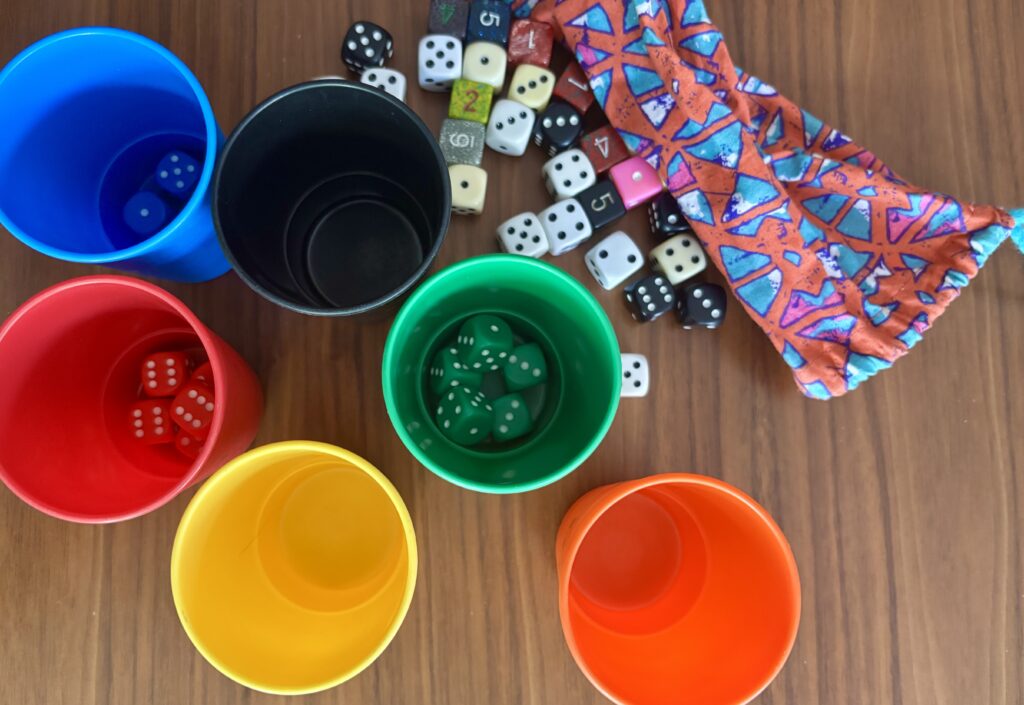
To play Perudo each player needs five normal six sided dice and a cup or container to shake them in. That’s it! During the game players lose dice and the goal is to be the last player with one or more dice remaining. Roll three dice to see who starts, whoever has the highest total will go first.
Simultaneously every player should shake their dice in their cup then flip the cup face down on the table so the dice are hidden underneath. Next, everyone can peek at their dice without showing the other players. You can peek as many times as you want but never change or reroll the dice until the round is over.
In a four player game there will be 20 dice total on the first round. The first player is going to make a guess or bid as to how many dice of a certain value (i.e. “fives”) all the players have under their cups. Ones are wild and count for the total, but cannot be bid on the first turn of a round. For example, a player might bid “four fives” meaning there are at least four fives AND ones under every player’s cup. Once a player makes a bid the next player, clockwise, will either have to increase the bid or call “dudo” – some people prefer “liar”, use whatever word your group enjoys and remembers.
Raising the bid is the most complicated thing to explain because you have a few options.
- First, you can increase the bid while keeping the number the same. In our example above that would mean you could bid “five fives”.
- Second, you can keep the bid the same and increase the number. In our example above that would mean you could bid “four sixes.”
- Third, you can increase the bid and change the number to whatever you want. So “four fives” could be changed to “six twos”.
- Fourth, after the first bid you can bid a value of one by dividing the current bid in half rounded up (or more). Our original bid of “four fives” could be changed to “two ones”.
- Finally, if you are bidding after a player bid ones you have two bid options, in addition to calling “dudo”. Either raise the number of ones “three ones” or double the current bid and increase it by one or more then change the value to any other number “two ones” becomes “five sixes”.
The bidding continues clockwise until a player calls “dudo”, then everyone raises their cups and counts the number of dice they have of the bid value AND ones. If the person bidding was successful because that many or more dice of the chosen value were rolled the person calling “dudo” loses one dice, otherwise the bidder loses one dice. Whoever lost a dice starts the next round after everyone rerolls their remaining dice. If someone loses their final dice they are out of the game and the next player clockwise starts the next round. When only one player has dice remaining they win.
We always play with one more rule that I believe is absolutely essential. When any player loses their fourth die (i.e. they only have one die remaining) there is a special round. That player will start the bidding and they are called a Palifico, which in Perudo means a player who only has one die. During this special round ones are NOT wild and the starting player can start the bidding with any value 1-6. In addition to the lack of wild ones, nobody except another Palifico can change the value bid, so if only one person is down to one die and they bid “fours” everyone MUST bid “fours” for this round. After the special round the rules return to normal until another player gets down to their final die.


2 responses to “Perudo: Cups Full Of Fun”
Did you put in there that we will hopefully get to play with you guys in Portugal while we are here?? Can you imagine a big conference call with everyone playing??
We did not put that in there, but you would have known that if you read the post. 🤣
I do see potential for playing Perudo on a video call and can’t wait to test that out! If we really want to try some games I know a few online sites we could play on and chat together.